


Updated data from the ongoing Phase 1b study of luveltamab tazevibulin (luvelta; STRO-002; Sutro BioPharma) in combination with bevacizumab (Avastin®; Genentech/Roche) for patients with epithelial ovarian cancer (EOC) were presented in a poster presentation at the 2024 European Society For Medical Oncology (ESMO) Congress held in Barcelona, Spain. [1]
 Folate receptor alpha or FRα, is a glycosylphosphatidylinositol (GPI-) linked cell-surface glycoprotein which binds and internalizes folic acid to support DNA and RNA synthesis during cell proliferation [2]. Although FolRα is normally expressed at low levels on the luminal surface of a small number of organs, high levels of FolRα have been observed in several malignancies, including, but not limited to, ovarian cancer and endometrial cancer. [2][3]
Based on a better understanding of the role that folate receptors play in the development and progression of cancer, researchers have developed several FR-targeted therapeutic approaches.
One such approach includes luveltamab tazevibulin, a folate receptor alpha (FRα-) targeting antibody-drug conjugate (ADC) designed to treat a broad range of patients with ovarian cancer, including those with lower FRα-expression who are not eligible for approved treatment options targeting FRα.


The investigational drug is a homogeneous ADC being developed and manufactured using Sutro BioPharma’s cell-free XpressCF® platform technology.[3] Luveltamab tazevibulin includes a novel protease cleavable 3-aminophenyl hemiasterlin linker-payload (SC209*) conjugated to the non-natural amino acid para-azidomethyl-L-phenylalanine which is precisely positioned to efficiently deliver to the tumor while ensuring systemic stability after dosing. The anti-FolRα antibody (SP8166) was discovered using ribosome display technology from a synthetic human Fab antibody library. [4] The drug-antibody ratio (DAR) is 4.
Luveltamab tazevibulin binds to FolRα with high affinity, internalizes rapidly into target positive cells, and releases the tubulin-targeting cytotoxin 3-aminophenyl hemiasterlin (SC209) payload. [2] This payload is a weaker substrate for the cellular efflux pump P-glycoprotein (P-gp) which, as a result, supports the use of luveltamab tazevibulin in select cancers with increased P-gp that are refractory to other chemotherapies, including as platinum agents, PARP inhibitors or some tubulin inhibitors. Furthermore, based on pre-clinical studies, the release of SC209 by FolRα-positive tumor cells induces bystander killing of FolRα-negative tumor cells. This, in turn, increases the efficacy of luveltamab tazevibulin in tumors with heterogeneous or low expression of FolRα.[2]
Ongoing and planned studies
The REFRαME-O1 study, a phase 2/3 registration-directed study for patients with platinum-resistant ovarian cancer is ongoing. Luveltamab tazevibulin is also investigated in ongoing trials in patients with endometrial cancer, non-small cell lung cancer, and in combination with bevacizumab in patients with ovarian cancer.
In addition to these studies, in the second half of 2024, Sutro expects to initiate REFRαME-P1 trial, a Phase 2/3 registration-directed study for pediatric patients with relapsed/refractory CBFA2T3-GLIS2 (CBF/GLIS) acute myeloid leukemia (AML), a distinct subtype of AML described by the Children’s Oncology Group (COG), commonly known as RAM phenotype AML.
CBF/GLIS2 acute myeloid leukemia (AML) is a rare subtype of pediatric cancer with high-intensity CD56 expression, dim-to-negative expression of CD45 and CD38, and a lack of HLA-DR expression. The disease, exclusively diagnosed in infants and very young children, is a uniformly refractory disease showing a distinctly high induction failure rate. It is clinically characterized by extremely poor prognosis (and high mortality). [5][6] The average of onset is 18 months [7]
To date, there are no approved therapies available to target this form of pediatric leukemia which is resistant to conventional chemotherapy and has an induction failure rate of over 80%. [8] As a result of this lack of effective treatment, children diagnosed with the disease have a dismal two-year survival rate of 15%. [7]
Recent studies have shown that FOLR1, which encodes for FolRα, is silent in normal hematopoiesis, but is uniquely induced by the CBF/GLIS fusion. Hence, initial research has shown that targeting FOLR1 with luveltamab tazevibulin effectively eliminates CBF/GLIS-positive AML in vitro and in vivo, providing a promising approach to improve outcomes in this high-risk AML subtype**. [9]
Fast Track Designation
The U.S. Food and Drug Administration (FDA) has granted luveltamab tazevibulin a Fast Track designation for Ovarian Cancer, as well as Orphan and Rare Pediatric Disease designations for CBF/GLIS2 Pediatric AML.
ESMO 2024
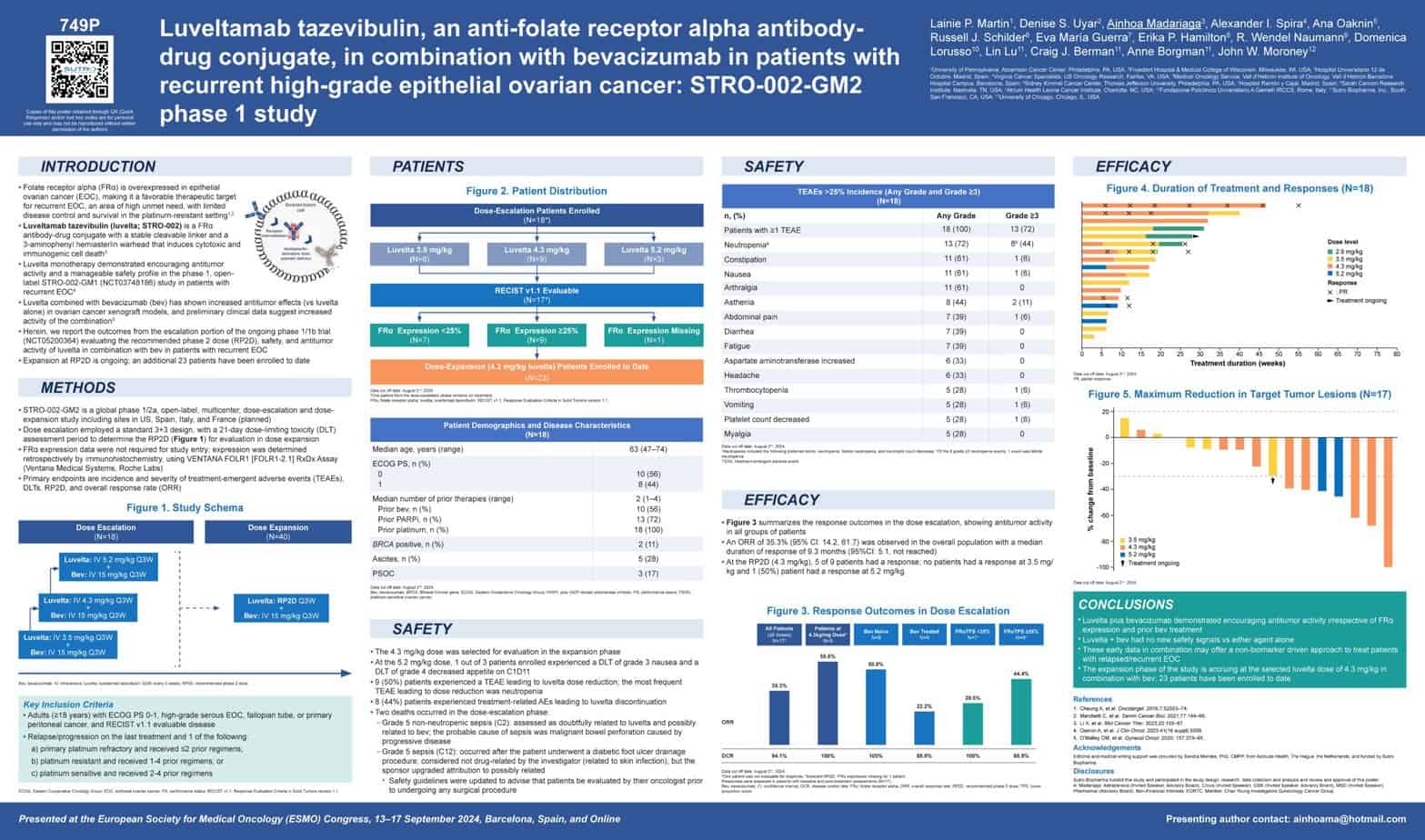
In this study presented at the 2024 ESMO congress, luveltamab tazevibulin plus bevacizumab demonstrated encouraging antitumor activity in patients with late-stage ovarian cancer irrespective of Folate Receptor-α (FRα) expression, including patients with no FRα expression, and prior bevacizumab treatment, with an overall response rate of 35%.[1]
These early data may offer a non-biomarker-driven approach to treating patients with epithelial ovarian cancer. The expansion phase of the study is ongoing at the recommended phase 2 dose (RP2D) of luveltamab tazevibulin (4.3 mg/kg) in combination with bevacizumab (15 mg/kg) with an additional 23 patients enrolled to date. Initial data is expected in the first half of 2025.[1]
“We are encouraged by these results achieved with luveltamab tazevibulin in combination with bevacizumab, which may offer the opportunity to benefit ovarian cancer patients regardless of FRα expression,” noted Jane Chung, Sutro’s President and Chief Operating Officer.
“We have already seen promising antitumor activity with luveltamab tazevibulin as a monotherapy treatment and we believe these combination data support our goal to deliver effective therapies to more patients living with cancer. We look forward to sharing initial results from our expansion phase in the first half of 2025,” Chung added.
 Poster Highlight:
- 18 patients were enrolled; one patient remains on treatment.
- Luveltamab tazevibulin plus bevacizumab demonstrated encouraging antitumor activity in 17 RECIST evaluable patients:
- At the RP2D (4.3 mg/kg), an Objective Response Rate (ORR) of 56% (5/9) was observed; no (0/6) patients had a response at 3.5 mg/kg and 50% (1/2) of patients had a response at 5.2 mg/kg.
- An ORR of 35% (6/17) was observed in the overall population with a median duration of response of 9.3 months.
- In patients with ≥25% FRα expression, an ORR of 44% (4/9) was observed; in patients with <25% FRα expression, an ORR of 29% (2/7) was observed.
- No new safety signals were observed compared with either agent alone; consistent with previously reported luveltamab tazevibulin safety results, the most common adverse event was neutropenia.
__
Note: * SC209 is a synthetic analogue of hemiasterlin, a natural compound derived from marine sponges which binds to the Vinca-peptide site of tubulin and disrupts normal microtubule dynamics to prevent the polymerization of microtubules. [10]
**As recently published in Blood, a publication of the American Society of Hematology, a targeted therapy with FOLR1-directed luveltamab tazevibulin was highly effective in eliminating CBF/GLIS-positive AML. As a result, researchers believe that and a combination of monthly luveltamab tazevibulin and donor lymphocyte infusions (DLI) appears to be feasible. [11]
Clinical trials
Study of STRO-002, an Anti-Folate Receptor Alpha (FolRα) Antibody Drug Conjugate in Ovarian & Endometrial Cancers – ClinicalTrials.gov ID NCT03748186
A Study of STRO-002, an Anti-Folate Receptor Alpha Antibody Drug Conjugate, in Combination With Bevacizumab in Epithelial Ovarian Cancer – ClinicalTrials.gov ID NCT05200364
REFRaME-O1: A Study to Investigate the Efficacy and Safety of Luveltamab Tazevibulin Versus Investigator’s Choice (IC) Chemotherapy in Women With Ovarian Cancer (Including Fallopian Tube or Primary Peritoneal Cancers) Expressing FOLR1 – ClinicalTrials.gov ID NCT05870748
Study to Investigate Luveltamab Tazevibulin in Adults With Advanced or Metastatic Non-small Cell Lung Cancer – ClinicalTrials.gov ID NCT06555263
Highlights of Prescribing Information
Bevacizumab (Avastin®; Genentech/Roche)[Prescribing Information]
References
[1] Martin LP, Uyae DS, Madariaga A, Spira AI, Oaknin A, Schilde RJ et al.Luveltamab tazevibulin, an anti-folate receptor alpha antibody-drug conjugate, in combination with bevacizumab in patients with recurrent high-grade epithelial ovarian cancer: STRO-002-GM2 phase 1 study. Poster 749 Presented at the European Society for Medical Oncology (ESMO) Congress, September 13 – 17, 2024, Barcelona, Spain.
[2] Li X, Zhou S, Abrahams CL, Krimm S, Smith J, Bajjuri K, Stephenson HT, Henningsen R, Hanson J, Heibeck TH, Calarese D, Tran C, Yin G, Stafford RL, Yam AY, Kline T, De Almeida VI, Sato AK, Lupher M, Bedard K, Hallam TJ. Discovery of STRO-002, a Novel Homogeneous ADC Targeting Folate Receptor Alpha, for the Treatment of Ovarian and Endometrial Cancers. Mol Cancer Ther. 2023 Feb 1;22(2):155-167. doi: 10.1158/1535-7163.MCT-22-0322. PMID: 36459691; PMCID: PMC9890132.
[3] Ledermann JA, Canevari S, Thigpen T. Targeting the folate receptor: diagnostic and therapeutic approaches to personalize cancer treatments. Ann Oncol. 2015 Oct;26(10):2034-43. doi: 10.1093/annonc/mdv250. Epub 2015 Jun 10. PMID: 26063635.
[4] Stafford RL, Matsumoto ML, Yin G, Cai Q, Fung JJ, Stephenson H, Gill A, You M, Lin SH, Wang WD, Masikat MR, Li X, Penta K, Steiner AR, Baliga R, Murray CJ, Thanos CD, Hallam TJ, Sato AK. In vitro Fab display: a cell-free system for IgG discovery. Protein Eng Des Sel. 2014 Apr;27(4):97-109. doi: 10.1093/protein/gzu002. Epub 2014 Feb 28. PMID: 24586053; PMCID: PMC3966677.
[5] Eidenschink Brodersen L, Alonzo TA, Menssen AJ, Gerbing RB, Pardo L, Voigt AP, Kahwash SB, Hirsch B, Raimondi S, Gamis AS, Meshinchi S, Loken MR. A recurrent immunophenotype at diagnosis independently identifies high-risk pediatric acute myeloid leukemia: a report from Children’s Oncology Group. Leukemia. 2016 Oct;30(10):2077-2080. doi: 10.1038/leu.2016.119. Epub 2016 May 2. PMID: 27133823; PMCID: PMC5136463.
[6] Conces M, Abu-Arja R, Reed S, Rangarajan HG, Guinipero TL, Loken MR, Brodersen LE, Kahwash SB. Acute Myeloid Leukemia with RAM Immunophenotype: A Pediatric Case with Unusual Morphologic Features. Hematol Rep. 2017 Jun 14;9(2):7057. doi: 10.4081/hr.2017.7057. PMID: 28670435; PMCID: PMC5477472.
[7] Tang T, Le Q, Castro S, Pardo L, McKay CN, Perkins L, Smith J, Kirkey D, Abrahams C, Bedard K, Molina A, Brodersen LE, Loken MR, Tarlock K, Meshinchi S, Loeb KR. Targeting FOLR1 in high-risk CBF2AT3-GLIS2 pediatric AML with STRO-002 FOLR1-antibody-drug conjugate. Blood Adv. 2022 Nov 22;6(22):5933-5937. doi: 10.1182/bloodadvances.2022008503. PMID: 36149945; PMCID: PMC9701621.
[8] Smith JL, Ries RE, Hylkema T, Alonzo TA, Gerbing RB, Santaguida MT, Eidenschink Brodersen L, Pardo L, Cummings CL, Loeb KR, Le Q, Imren S, Leonti AR, Gamis AS, Aplenc R, Kolb EA, Farrar JE, Triche TJ Jr, Nguyen C, Meerzaman D, Loken MR, Oehler VG, Bolouri H, Meshinchi S. Comprehensive Transcriptome Profiling of Cryptic CBFA2T3-GLIS2Fusion-Positive AML Defines Novel Therapeutic Options: A COG and TARGET Pediatric AML Study. Clin Cancer Res. 2020 Feb 1;26(3):726-737. doi: 10.1158/1078-0432.CCR-19-1800. Epub 2019 Nov 12. PMID: 31719049; PMCID: PMC7002196.
[9] Le Q, Smith JL, Tang T, Castro S, McKay CN, Perkins L, et al. Targeting FOLR1 in High-Risk CBFA2T3-GLIS2 AML with Stro-002 FOLR1-Directed Antibody-Drug Conjugate, Blood, Volume 138, Supplement 1, 2021, Page 209, ISSN 0006-4971
[10] Loganzo F, Discafani CM, Annable T, Beyer C, Musto S, Hari M, Tan X, Hardy C, Hernandez R, Baxter M, Singanallore T, Khafizova G, Poruchynsky MS, Fojo T, Nieman JA, Ayral-Kaloustian S, Zask A, Andersen RJ, Greenberger LM. HTI-286, a synthetic analogue of the tripeptide hemiasterlin, is a potent antimicrotubule agent that circumvents P-glycoprotein-mediated resistance in vitro and in vivo. Cancer Res. 2003 Apr 15;63(8):1838-45. PMID: 12702571.
[11] Andrews K, Meshinchi S, Marri P, Siddiqui AH, Polski J, Molina A, Chewning J, Brodersen LE, Hudson CA, Imran H. Pediatric Acute Myeloid Leukemia with Co-Occurring BCR::ABL and CBFA2T3::GLIS2Dual Fusion with Deep Response to FOLR1-Targeting Antibody Drug Conjugate Stro-002 and Tyrosine Kinase Inhibitor/ Blood (2022) 140 (Supplement 1): 11757–11758. https://doi.org/10.1182/blood-2022-164629
Featured image: ESMO 2019 General. Photo courtesy: © 2019 – 2024 ESMO. used with permission.
DOI: 10.14229/jadc.2024.09.16.004


