



First-in-human data for Adcendo’s uPARAP-directed ADC, presented today at the 2026 EORTC-NCI-AACR Symposium in Barcelona, show partial responses in eight of 27 previously treated patients with advanced soft tissue sarcoma.
Key takeaways
- ADCE-D01, an investigational antibody-drug conjugate (ADC) targeting uPARAP, produced an objective response rate (ORR) of 30% and a disease control rate (DCR) of 85% among 27 response-evaluable patients receiving treatment every two weeks in the Phase 1 ADCElerate1 study.
- At the data cutoff, five of eight partial responses were confirmed, with all eight responses ongoing. Median duration of response had not yet been reached.
- The every-two-week dosing schedule demonstrated a manageable preliminary safety profile, with no treatment-related discontinuations and dose reductions in 10% of patients.
Early clinical activity
Adcendo ApS has reported initial clinical results from the ongoing Phase 1 ADCElerate1 study (NCT06797999), evaluating ADCE-D01, an investigational antibody-drug conjugate targeting urokinase plasminogen activator receptor-associated protein (uPARAP), in adults with advanced soft tissue sarcoma (STS). Soft tissue sarcomas are rare and highly heterogeneous cancers comprising more than 100different tumor subtypes, with an estimated incidence of 4-5 cases per 100,000 people annually in Europe and ~3.5 new diagnoses per 100,000 people in the United States each year. [1][2]
 The findings were presented on November 19, 2026, during a late-breaking oral presentation at the 38th EORTC-NCI-AACR Symposium on Molecular Targets and Cancer Therapeutics in Barcelona, Spain. The presentation was included in Plenary Session 3, devoted to clinical trials.
Among 27 response-evaluable patients treated with ADCE-D01 every two weeks (Q2W), eight achieved a partial response, corresponding to an ORR of 30%. Five responses were confirmed, while three remained unconfirmed at the data cutoff. Disease control was observed in 23 patients (DCR 85%). The 27 response-evaluable patients represented 12 STS subtypes. All eight partial responses were ongoing at the time of analysis.


Median follow-up was 3.4 months, and median duration of response had not been reached. At the data cutoff, 22 of the 27 response-evaluable patients (81%) remained on treatment. Adcendo also reported a trend toward greater activity at higher dose levels; longer follow-up is needed to confirm the dose-response relationship. The data are preliminary. The population is small and nonrandomized; three of the eight responses were unconfirmed at cutoff, and median follow-up was 3.4 months.
ADCE-D01 targets uPARAP
ADCE-D01 is designed to exploit uPARAP expression, also known as Endo180, MRC2, or CD280. This transmembrane endocytic receptor is involved in collagen uptake and extracellular matrix remodeling. Because uPARAP is expressed in mesenchymal malignancies and is internalized and recycled through the endosomal-lysosomal pathway, it is a candidate target for drug delivery.
An earlier preclinical investigation by Nielsen and colleagues in Oncotarget (2017) showed that uPARAP/Endo180 could serve as a target for ADC-mediated treatment. The investigators developed a uPARAP-directed ADC incorporating a monoclonal antibody, a cathepsin-cleavable valine-citrulline linker, and the cytotoxic payload monomethyl auristatin E (MMAE). The construct demonstrated receptor-dependent cytotoxicity in uPARAP-expressing sarcoma, glioblastoma, and leukemia cell models. The study also reported antitumor activity in a xenograft model. [3]
Earlier supporting research
In separate work, Evans and colleagues developed an uPARAP (Endo180; MRC2)-targeted ADC and reported antitumor activity in preclinical sarcoma models, adding independent support for the receptor as an ADC target in this disease. [4]
In an immunohistochemical analysis of 625 human soft-tissue sarcoma samples, Evans and colleagues identified strong tumor-cell expression of uPARAP in a substantial proportion of tumors. Gene-expression analyses supported these findings, showing significantly higher Endo180 expression in both soft-tissue and bone sarcomas than in normal tissues.
The investigators further explored uPARAP’s therapeutic potential as a target for antibody-drug conjugate (ADC) development. Because uPARAP is a constitutively recycling transmembrane receptor, it enables efficient antibody internalization and intracellular payload delivery. An anti-uPARAP monoclonal antibody conjugated to the antimitotic agent monomethyl auristatin E (MMAE) through a cleavable linker was rapidly internalized by target-expressing cells and trafficked to lysosomes, resulting in selective cytotoxicity in uPARAP-expressing sarcoma cell lines.
In a sarcoma xenograft model, treatment with the uPARAP-vc-MMAE ADC induced on-target cytotoxic activity, resulting in tumor regression. The investigators also observed a significant reduction in metastatic colonization of the lungs, liver, and lymph nodes. These effects were not observed with either an isotype-matched vc-MMAE control ADC or the unconjugated uPARAP antibody, supporting the contribution of targeted MMAE delivery to the antitumor activity observed.
In a 2026 study published in Translational Oncology, Wang and colleagues evaluated uPARAP expression in sarcoma tissue samples and normal tissues using immunohistochemistry and tissue microarrays. The investigators reported limited expression in normal tissues and high expression in several sarcoma subtypes. More than 80% of highly positive cases were observed in selected groups, including fibrosarcoma, synovial sarcoma, undifferentiated pleomorphic sarcoma, malignant peripheral nerve sheath tumors, and several bone sarcoma subtypes. [5]
These data support uPARAP as a therapeutic target, but expression alone does not predict response. Whether tumors with high uPARAP expression respond better to ADCE-D01 remains unknown.
Antibody, cleavable linker, and topoisomerase I inhibitor payload
ADCE-D01 combines a humanized antibody directed against uPARAP with a protease-cleavable linker and a topoisomerase I inhibitor payload. According to Adcendo, the antibody has been designed to bind uPARAP without interfering with its natural collagen ligand interaction. After binding and internalization, the ADC is processed inside the cell, releasing its payload.
Because the receptor recycles constitutively, it can continuously deliver antibody-bound payload into tumor cells. The payload puts ADCE-D01 in the same class as other topoisomerase I inhibitor ADCs, such as trastuzumab deruxtecan and sacituzumab govitecan. What sets it apart is the target. Adcendo has reported preclinical activity for ADCE-D01 in multiple mesenchymal tumor models.
Phase 1 safety findings and dose optimization
The ADCElerate1 study (NCT06797999) has enrolled 47 adults with advanced STS representing 17 different histological subtypes. Participants had received previous systemic treatment, including chemotherapy and targeted agents. The median number of prior treatment lines was 2 (range, 1 to 4). For patients whose advanced STS progresses after first-line chemotherapy, the options set out in current ESMO-EURACAN-GENTURIS and SELNET guidelines are limited and often histology-specific. [1][6] The initial 18 patients received weekly ADCE-D01 at doses ranging from 0.5 to 3.4 mg/kg.
After evaluating the pharmacokinetic findings, the study transitioned to an every-two-week schedule. The subsequent 29 patients received doses ranging from 3.4 to 5.5 mg/kg. Patients receiving doses above 3.4 mg/kg also received prophylactic granulocyte colony-stimulating factor (G-CSF).
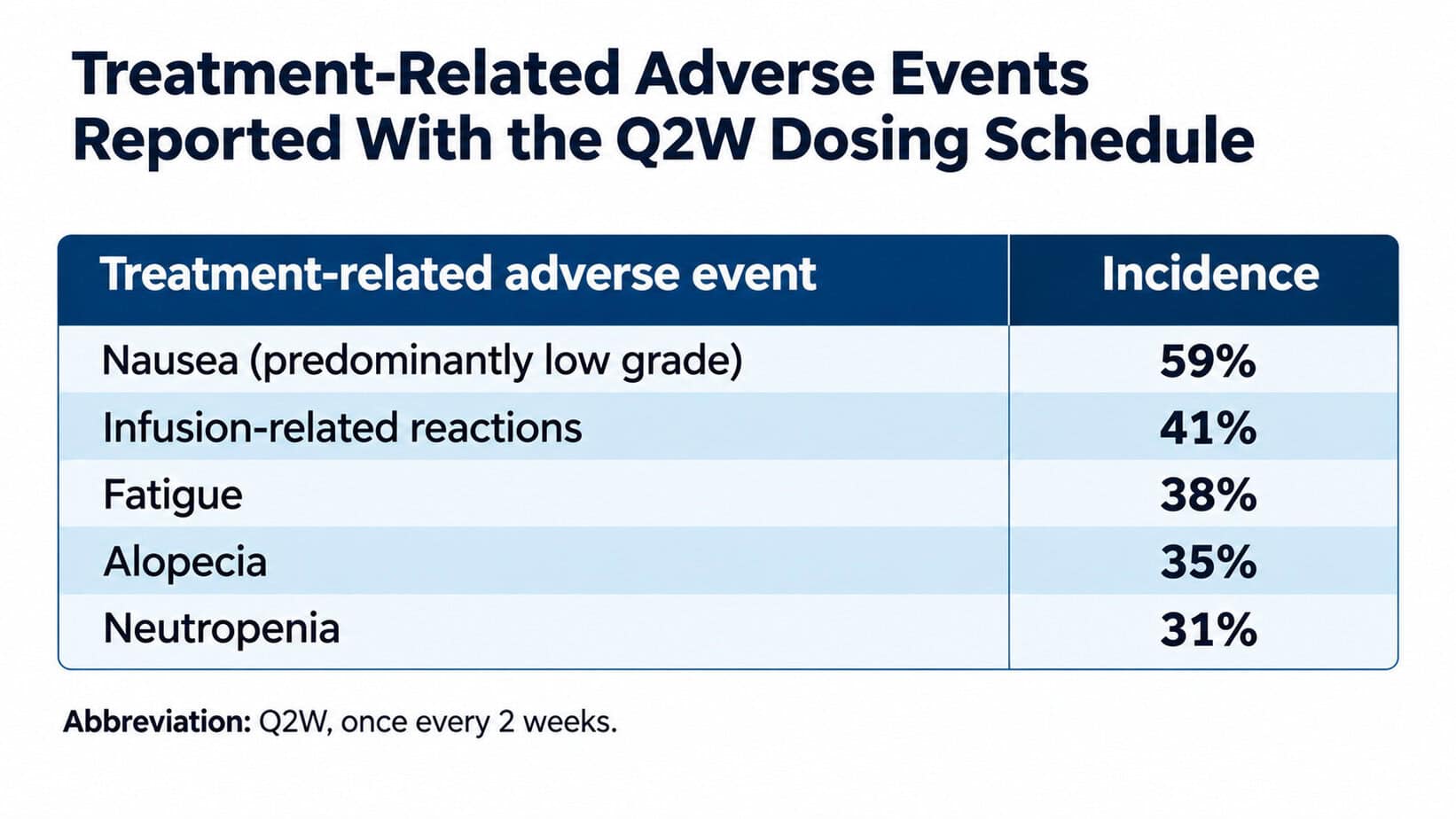 Treatment-related adverse events resulted in dose reductions in 10% of patients receiving the Q2W regimen. No patients in this dosing cohort discontinued treatment because of treatment-related adverse events. Neutropenia was the most frequently reported hematological adverse event. Among patients receiving prophylactic G-CSF, grade 3 or higher neutropenia occurred in three of 22 patients (14%). In comparison, three of seven patients (43%) who did not receive prophylactic G-CSF experienced grade 3 or higher neutropenia.
The rate was lower in the G-CSF group even though those patients received higher ADCE-D01 doses. With 22 and 7 patients, the comparison is descriptive and cannot establish how well prophylactic G-CSF works. No cases of interstitial lung disease, febrile neutropenia, or stomatitis were reported in the Q2W cohort. The maximum tolerated dose for the every-two-week regimen had not been reached at the time of the reported analysis. Enrollment on this schedule remains ongoing.
ADCElerate1: First-in-human Phase 1/2 clinical investigation
ADCElerate1 is a first-in-human, multicenter, open-label Phase 1/2 study evaluating ADCE-D01 as monotherapy in patients with metastatic and/or unresectable soft tissue sarcoma. The main objectives include evaluating the safety and tolerability of ADCE-D01 and determining the maximum tolerated dose or maximum administered dose, together with the recommended Phase 2 dose and schedule.
Secondary objectives include characterizing the pharmacokinetic profile and assessing preliminary antitumor activity.
Regulatory designations and continued development
ADCE-D01 has received Fast Track Designation and Orphan Drug Designation from the U.S. Food and Drug Administration (FDA) for the treatment of soft tissue sarcoma. Dose escalation and expansion continue, with further enrollment planned to define safety, pharmacokinetics, and antitumor activity. These are the first clinical data showing antitumor activity from uPARAP-directed drug delivery in previously treated patients with advanced STS.
The next questions are how long responses last, what the recommended Phase 2 dose will be, and which sarcoma subtypes benefit most. No approved ADC targets uPARAP. The expansion phase of ADCElerate1 will show whether the receptor’s expression and internalization translate into durable clinical benefit in advanced sarcoma.
Clinical trial
First-in-Human Study of ADCE-D01 in Soft Tissue Sarcoma (ADCElerate1) – ClinicalTrials.gov ID NCT06797999
References
[1] Gronchi A, Miah AB, Dei Tos AP, Abecassis N, Bajpai J, Bauer S, Biagini R, Bielack S, Blay JY, Bolle S, Bonvalot S, Boukovinas I, Bovee JVMG, Boye K, Brennan B, Brodowicz T, Buonadonna A, De Álava E, Del Muro XG, Dufresne A, Eriksson M, Fagioli F, Fedenko A, Ferraresi V, Ferrari A, Frezza AM, Gasperoni S, Gelderblom H, Gouin F, Grignani G, Haas R, Hassan AB, Hecker-Nolting S, Hindi N, Hohenberger P, Joensuu H, Jones RL, Jungels C, Jutte P, Kager L, Kasper B, Kawai A, Kopeckova K, Krákorová DA, Le Cesne A, Le Grange F, Legius E, Leithner A, Lopez-Pousa A, Martin-Broto J, Merimsky O, Messiou C, Mir O, Montemurro M, Morland B, Morosi C, Palmerini E, Pantaleo MA, Piana R, Piperno-Neumann S, Reichardt P, Rutkowski P, Safwat AA, Sangalli C, Sbaraglia M, Scheipl S, Schöffski P, Sleijfer S, Strauss D, Strauss S, Sundby Hall K, Trama A, Unk M, van de Sande MAJ, van der Graaf WTA, van Houdt WJ, Frebourg T, Casali PG, Stacchiotti S; ESMO Guidelines Committee, EURACAN and GENTURIS. Electronic address: clinicalguidelines@esmo.org. Soft tissue and visceral sarcomas: ESMO-EURACAN-GENTURIS Clinical Practice Guidelines for diagnosis, treatment and follow-up☆. Ann Oncol. 2021 Nov;32(11):1348-1365. doi: 10.1016/j.annonc.2021.07.006. Epub 2021 Jul 22. PMID: 34303806.
[2] Cancer Stat Facts: Soft Tissue including Heart Cancer. National Cancer Institute SEER Program. 2026 Estimates. Online. Last accessed on November 19, 2026
[3] Nielsen CF, van Putten SM, Lund IK, Melander MC, Nørregaard KS, Jürgensen HJ, Reckzeh K, Christensen KR, Ingvarsen SZ, Gårdsvoll H, Jensen KE, Hamerlik P, Engelholm LH, Behrendt N. The collagen receptor uPARAP/Endo180 as a novel target for antibody-drug conjugate mediated treatment of mesenchymal and leukemic cancers. Oncotarget. 2017 Jul 4;8(27):44605-44624. doi: 10.18632/oncotarget.17883. PMID: 28574834; PMCID: PMC5546505.
[4] Evans RJ, Perkins DW, Selfe J, Kelsey A, Birch GP, Shipley JM, Schipper K, Isacke CM. Endo180 (MRC2) Antibody-Drug Conjugate for the Treatment of Sarcoma. Mol Cancer Ther. 2023 Feb 1;22(2):240-253. doi: 10.1158/1535-7163.MCT-22-0312. PMID: 36399638; PMCID: PMC9890142.
[5] Wang CC, Barkholt P, Wozniak A, Vanleeuw U, Lee CJ, De Sutter L, De Cock L, Verbeeck K, Engelholm LH, Lynch C, Mumberg D, Schöffski P. Molecular epidemiology of the expression of urokinase plasminogen activator receptor-associated protein (uPARAP) in mesenchymal malignancies. Transl Oncol. 2026 Apr;66:102708. doi: 10.1016/j.tranon.2026.102708. Epub 2026 Feb 23. PMID: 41734474; PMCID: PMC13080477.
[6] Blay JY, Hindi N, Bollard J, Aguiar S Jr, Angel M, Araya B, Badilla R, Bernabeu D, Campos F, Caro-Sánchez CHS, Carvajal B, Carvajal Montoya A, Casavilca-Zambrano S, Castro-Oliden V, Chacón M, Clara M, Collini P, Correa Genoroso R, Costa FD, Cuellar M, Dei Tos AP, Dominguez Malagon HR, Donati D, Dufresne A, Eriksson M, Farias-Loza M, Fernandez P, Frezza AM, Frisoni T, Garcia-Ortega DY, Gelderblom H, Gouin F, Gómez-Mateo MC, Gronchi A, Haro J, Huanca L, Jimenez N, Karanian M, Kasper B, Lopes David BB, Lopez-Pousa A, Lutter G, Martinez-Said H, Martinez-Tlahuel J, Mello CA, Morales Pérez JM, Moura David S, Nascimento AG, Ortiz-Cruz EJ, Palmerini E, Patel S, Pfluger Y, Provenzano S, Righi A, Rodriguez A, Salas R, Santos TTG, Scotlandi K, Soule T, Stacchiotti S, Valverde C, Waisberg F, Zamora Estrada E, Martin-Broto J. SELNET clinical practice guidelines for soft tissue sarcoma and GIST. Cancer Treat Rev. 2022 Jan;102:102312. doi: 10.1016/j.ctrv.2021.102312. Epub 2021 Nov 14. Erratum in: Cancer Treat Rev. 2023 Apr;115:102523. doi: 10.1016/j.ctrv.2023.102523. PMID: 34798363.
Featured image © 2026 Barcelona, Spain; by Florian Schmid on Unsplash. Used with permission.
DOI


