


Shanghai (China) base CStone Pharmaceuticals has submitted a Phase 1b clinical trial application in Australia for CS5001 (previously known as LCB71; see drugmap), a receptor tyrosine kinase-like orphan receptor 1 (ROR1-) targeting antibody-drug conjugate (ADC), in combination with first-line standard-of-care (SoC) for the treatment of Diffuse large B cell lymphoma (DLBCL) is a type of non-Hodgkin lymphoma (NHL).
CS5001 is also being evaluated as both a monotherapy and in combination with a PD-L1 inhibitor for advanced solid tumors in an ongoing global multi-center clinical trial.
ROR1
Receptor tyrosine kinase-like orphan receptor 1 (ROR1) is a member of the receptor tyrosine kinase family. ROR1 is selectively over-expressed in a number of solid and hematological malignancies without significant expression in normal adult tissues. [1]
Drug design
CS5001 has been uniquely designed with proprietary tumor-cleavable linker and pyrrolobenzodiazepine prodrug. Only after reaching the tumor, the linker and prodrug are cleaved to release the PBD toxin, resulting in lethal DNA cross-links in cancer cells. The use of the linker plus PBD prodrug effectively helps address the toxicity associated with traditional PBD payloads, leading to a better safety profile.


In preclinical studies, CS5001 has demonstrated complete tumor suppression in several preclinical cancer models and demonstrated favorable serum half-life and pharmacokinetic characteristics.
Additionally, CS5001 utilizes site-specific conjugation for a precise drug antibody ratio of which enables homogeneous production and large-scale manufacturing.
Building on promising data from CS5001 monotherapy in later-line aggressive and indolent lymphomas, this Phase 1b trial aims to expand the therapeutic potential of CS5001 across all DLBCL stages and solid tumors.
The Australian study are expected to explore:
- CS5001 + R-CHOP: First-line treatment for DLBCL patients who have not received prior systemic therapy.
- CS5001 + SoC: For patients with relapsed or refractory DLBCL.
- CS5001 Monotherapy: Targeting ROR1-expressing solid tumors.
- CS5001 + Sugemalimab: Combination therapy for advanced solid tumors.
“We are thrilled to reach another key clinical milestone for CS5001. The existing data underscore its broad potential in both lymphomas and solid tumors. Notably, a ROR1 ADC combined with R-CHP has demonstrated an impressive complete response (CR) rate in a Phase II trial for first-line DLBCL,” noted Jason Yang, MD, Ph.D, Chief Executive Officer and President of R&D of CStone.
“As we advance from late-line monotherapy to frontline combination therapy, we are optimistic that CS5001 will provide significant clinical benefits to DLBCL patients and establish itself as a first-line treatment option. Meanwhile, we continue to explore CS5001’s potential in solid tumors and eagerly anticipate further positive outcomes,” Yang added.
Clinical development
The first-in-human data for CS5001 in patients with advanced solid tumors and lymphomas was presented at the 2024 American Society of Clinical Oncology (ASCO) Annual Meeting.
The outcomes of this study showed that CS5001, so far the first anti-ROR1 ADC known to show clinical anti-tumor activity in both solid tumors and lymphomas, was well tolerated without dose-limiting toxicity (DLT) identified, PK characteristics were as expected, and encouraging anti-tumor activities were observed in various advanced solid tumors and lymphomas. Based on these results, researchers confirmed that the data supported continued evaluations for the recommended phase 2 dose and subsequent phase 1b dose expansion. [2]
Additionally, the latest clinical data on CS5001 as a monotherapy in patients with advanced lymphomas has recently been presented at the 66th American Society of Hematology (ASH) Annual Meeting.
In this study CS5001 demonstrated encouraging safety and robust anti-tumor activity in the Phase 1a dose escalation trials across 10 dose levels.
- The data presented at American Society of Hematology meeting highlighted the latest safety and efficacy of CS5001 as a monotherapy for patients with advanced lymphomas.
- The data showed that CS5001 is well tolerated in heavily pre-treated patients with advanced B-cell lymphoma. No dose-limiting toxicity (DLT) has been reported up to dose level 10 (DL10).
- At the preliminary recommended Phase 2 dose (RP2D) of DL8 (125 μg/kg), a notably higher ORR of 76.9% was observed in advanced B-cell lymphoma, including 3 evaluable HL cases with complete or partial response, and an ORR of 70% in NHL.
- Encouraging efficacy signals were also observed in advanced solid tumors, including non-small cell lung cancer and pancreatic cancer.
- CS5001 was well tolerated in heavily pre-treated patients with advanced B-cell lymphomas and solid tumors.
Patient baseline characteristics
A total of 33 patients with advanced B-cell lymphoma were enrolled, including 17 diffuse large B-cell lymphoma (DLBCL), 11 HLs, 2 follicular lymphoma (FL), 1 mantle cell lymphoma (MCL), 1 marginal zone lymphoma (MZL), and 1 high-grade B-cell lymphoma (HGBCL).
Among them, 84.8% were Asian, and the rest were non-Asian. 81.8% of the patients had received at least 3 prior lines of systemic anti-tumor therapy. In the DL8 cohort, patients who had previously received CART and hematopoietic stem cell transplantation therapy each accounted for over 20%.
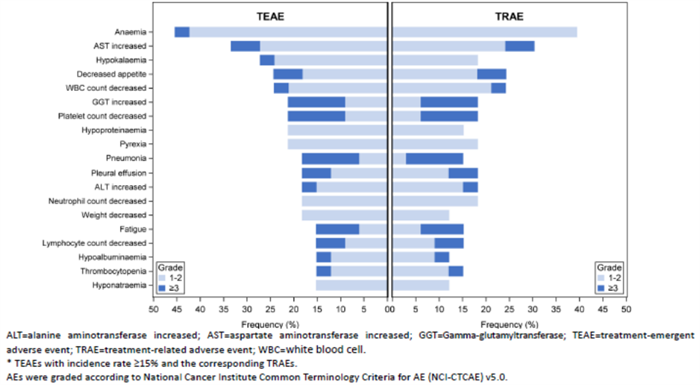
Safety and tolerability
Dose escalation has been completed and no DLT has been reported up to DL10 so far.
Efficacy Results
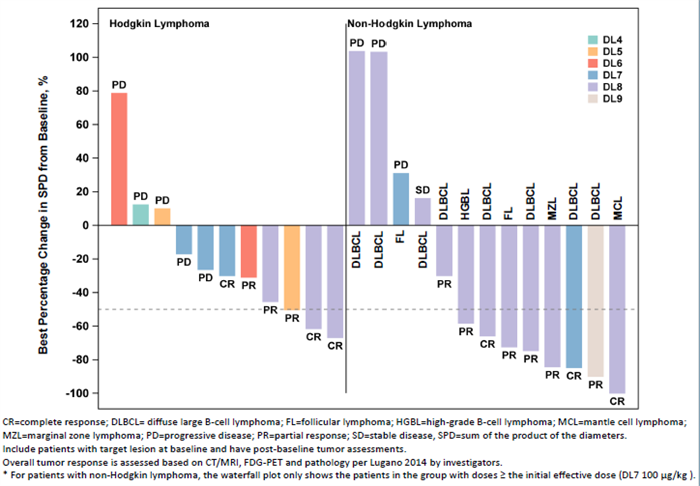
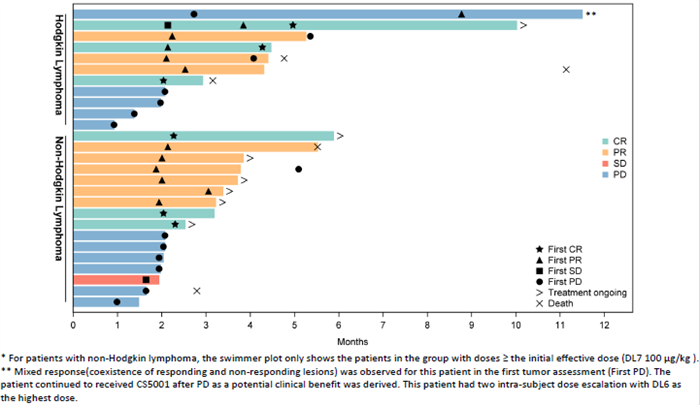
CS5001 demonstrated encouraging anti-tumor activity in B-cell lymphomas, with an ORR of 48.4% across all dose levels; a notably higher ORR of 76.9% was observed at DL8 (125 μg/kg) among 13 evaluable patients.
- Hodgkin Lymphoma (HL): objective responses were observed from effective dose of DL5 (50 μg/kg) and above, including 3 complete responses (CRs) and 3 partial responses (PRs) among 10 evaluable patients at DLs 5-9 (ORR: 60.0%). 2 CRs and 1 PR were observed at DL8 (125 μg/kg) among 3 evaluable patients.
- Non-Hodgkin Lymphoma (NHL): objective responses were observed from effective dose of DL7 (100 μg/kg) and above, including 3 CRs (2 DLBCL and 1 MCL) and 6 PRs (3 DLBCL, 1 MZL, 1 HGBC and 1 FL) among 16 evaluable patients at DLs 7-9 (ORR: 56.3%). A notably higher ORR of 70.0% was observed at DL8 (125 μg/kg) among 10 evaluable patients.
The global multicenter Phase 1 trial of CS5001 are currently in progress in the United States, Australia, and China. Dose escalation has been completed. Backfilling at DL8 (125 μg/kg) or DL9 (156 μg/kg) is still ongoing.
A Phase 1b dose-expansion study with potential for registration across multiple tumor types is expected to be initiated soon.
Global approach
The global multi-center Phase Ib trial for CS5001 is actively enrolling patients across the United States, Australia, and China. Recruitment is ongoing for monotherapy cohorts targeting aggressive and indolent advanced lymphomas, which could potentially expand into a Phase 2 single-arm registration study. Additional cohorts, including the first-line DLBCL combination therapy and solid tumor monotherapy and combination therapy arms, will be initiated soon.
Licensing agreement
In October 2020, CStone signed a licensing agreement with LigaChem Biosciences for the development and commercialization of CS5001 which was originally generated by collaboration of LigaChem Biosciences and ABL Bio, both South Korea-based biotech companies.
Under the agreement, CStone obtains the exclusive global right to develop and commercialize CS5001 outside the Republic of Korea.
_
Clinical Trials
A Study of CS5001 in Patients With Advanced Solid Tumors and Lymphomas – ClinicalTrials.gov ID NCT05279300
Reference
[1] Shabani M, Naseri J, Shokri F. Receptor tyrosine kinase-like orphan receptor 1: a novel target for cancer immunotherapy. Expert Opin Ther Targets. 2015 Jul;19(7):941-55. doi: 10.1517/14728222.2015.1025753. Epub 2015 Apr 2. PMID: 25835638.
[2] Lemech CR, Zuniga R, Barve MA, Song Y, Zhang J, Zhou K, Zhang L, Shen L, Bishnoi S, Cherng HJJ, Zhou C, Li W, Wang J, Zhu X, Zhu D, Li F, Shen Z, Yang J. A phase 1a/b, multi-regional, first-in-human study of CS5001, a novel anti-ROR1 ADC, in patients with advanced solid tumors and lymphomas. Journal of Clinical Oncology 2024 42:16_suppl, 3023-3023


