

The antibody-drug conjugate (ADC) landscape is at a critical inflection point, where manufacturing complexity threatens to stifle innovation amid unprecedented market demand. With over 210 ADCs in clinical development,[1] innovative biotechnology companies face an increasingly sophisticated challenge: managing conjugation bottlenecks, manufacturing yields, and regulatory complexity with contract development and manufacturing organizations (CDMOs) while competing against well-resourced pharmaceutical giants. Research published by Wei Huang, Ph.D., et al in Acta Pharmaceutica Sinica B [2] reveals an innovative solution that provides one-step synthesis of glycosite-specific ADCs, achieving over 95% conjugation yields in under one hour.
This technological leap addresses the most pressing pain points facing ADC developers and their CDMO partners: manufacturing inefficiencies and unpredictability that can derail clinical timelines, cost structures that demand tens of millions of dollars in specialized facility investments, and quality control challenges that create regulatory uncertainty. A one-step glycoengineering strategy eliminates potential heterogeneity, producing clean, well-defined ADCs confirmed by mass spectrometry, size-exclusion chromatography, and hydrophobic interaction chromatography. By dramatically simplifying conjugation, improving uniformity, and enhancing stability, this one-step platform delivers manufacturing predictability and therapeutic reliability critical for successful clinical translation.
The Manufacturing Challengers Facing ADC Innovation
Antibody–drug conjugates (ADCs) continue to represent among the most powerful therapeutic classes in oncology, combining the specificity of monoclonal antibodies with the potency of cytotoxic payloads. As the ADC field continues to expand with more than 210 candidates in clinical development globally, the ability to develop and manufacture reliably and efficiently will be a decisive competitive factor.
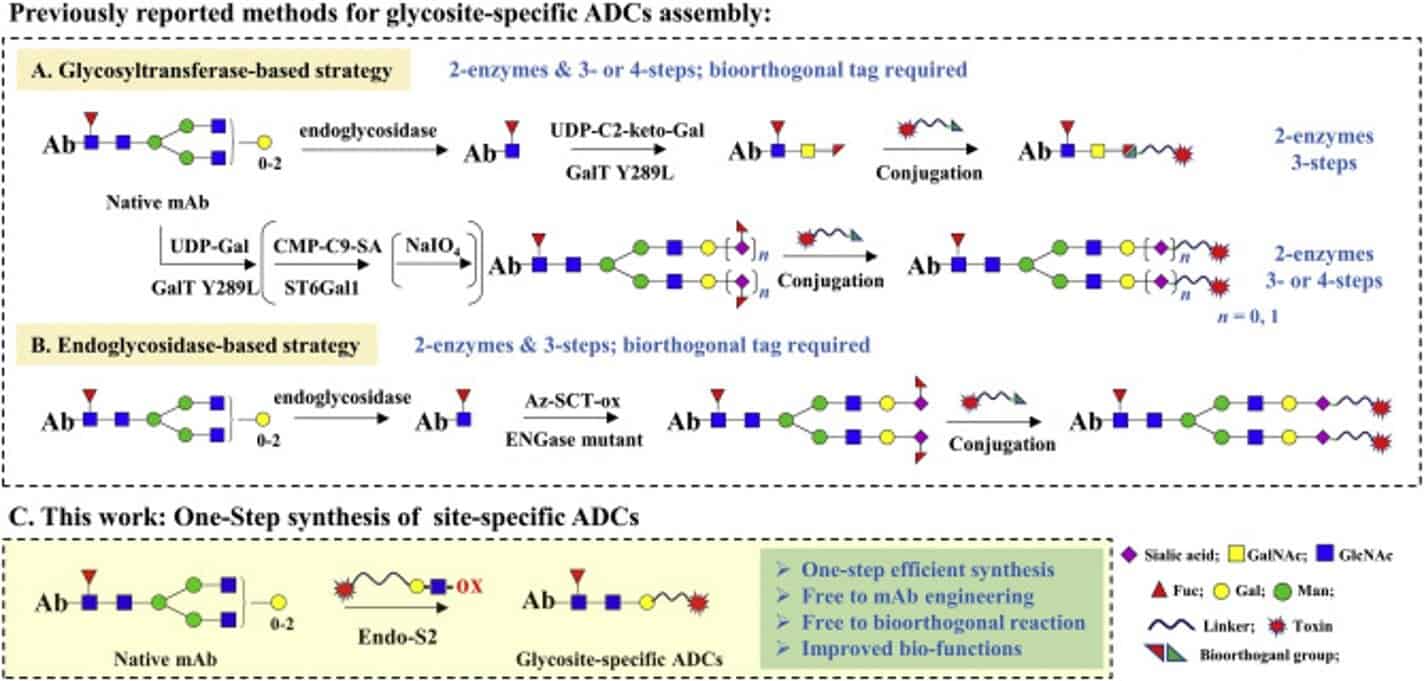 |
| Figure 1.0: Strategies for synthesis of glycosite-specific ADCs |
Yet despite their clinical promise, their development remains constrained by manufacturing bottlenecks. Traditional conjugation methods are typically multi-step, labor-intensive, and analytically demanding.
For biotechnology and biopharmaceutical companies operating under financial and timeline pressures, and for CDMOs tasked with delivering high-quality conjugates at scale, these complexities can slow progress and amplify risk. Dr. Wei Huang et al have introduced an approach that challenges these limitations. By reprogramming IgG [3]glycoengineering with LacNAc-based substrates in the presence of wild-type Endo-S2 [4], they demonstrated that native antibodies can be converted into homogeneous glycosite-specific ADCs (gsADCs) in a single step, achieving yields above 95% in just 1 hour.
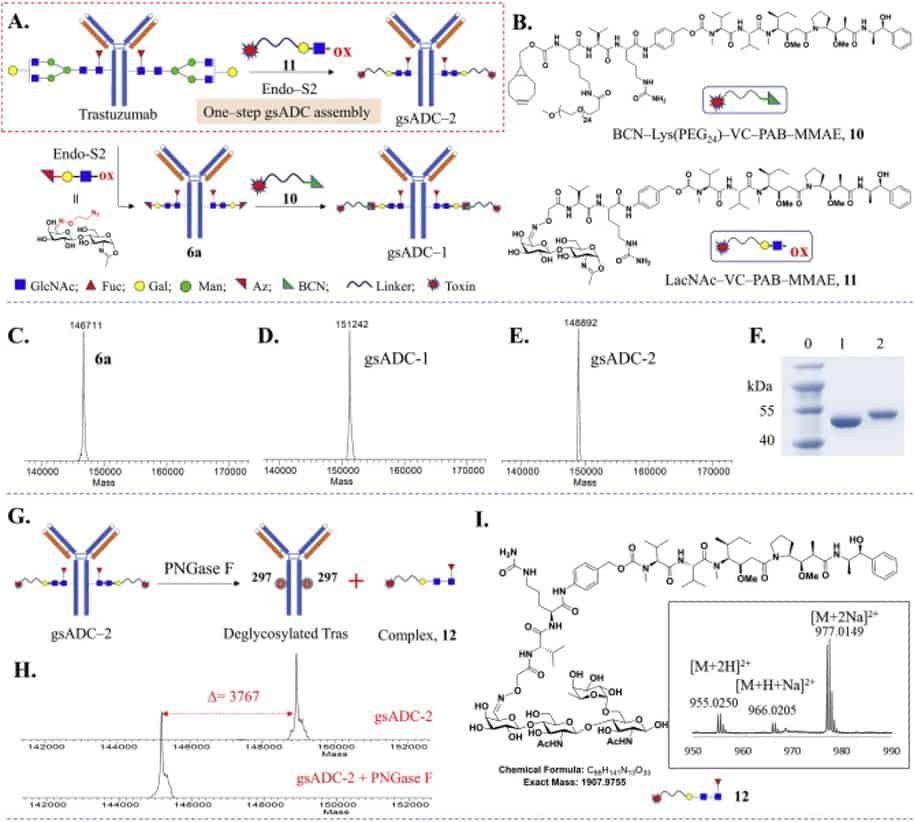 |
Figure 2.0: Synthesis of glycosite-specific ADCs using LacNAc-based substrates (A) General procedure of one-step or two-step synthesis of gsADCs. (B) Small molecules used in the assembly of gsADCs. (C–E), LC‒MS profiles of Az-LacNAc-Tras 6a (C), gsADC-1 (D), and gsADC-2 (E). (F) SDS-PAGE of one-step synthesis of gsADC-2. Lane 0: protein marker; Lane 1: deglycosylated Tras (1a); Lane 2: gsADC-2. (G) Conjugation-site analysis of gsADC-2 via PNGase F digestion. (H) Antibody molecular weight of gsADC-2 after digestion with PNGase F. (I) HRMS profile of glycan–drug complex released from gsADC-2. |
Conventional workflows often require sequential enzymatic or chemical steps to remodel glycans, attach linkers, and conjugate payloads, each necessitating intermediate purification and characterization. These incremental processes not only lengthen production timelines but also increase cleanroom occupancy, regulatory documentation requirements, and the potential for failure points. In contrast, the one-step LacNAc strategy collapses these stages into a single, streamlined reaction, resulting in greater facility throughput, reduced scheduling congestion, and a more reliable, reproducible platform for client programs. For biotechs, it offers faster access to clinical-grade material and clearer visibility into cost and risk profiles.
One of the most significant benefits of the approach lies in its ability to generate homogeneous ADCs with a defined drug-to-antibody ratio (DAR). Traditional conjugation strategies frequently produce heterogeneous mixtures, with DAR values ranging from 0 to 8, resulting in populations of under-conjugated species with reduced efficacy and over-conjugated molecules with increased toxicity. This heterogeneity complicates analytical characterization and quality control, as ADC developers must deploy extensive high-resolution mass spectrometry and chromatographic separations to dissect product distributions.
Wei Huang et al. demonstrated that their one-step glycoengineering strategy eliminates this heterogeneity, producing clean, well-defined ADCs confirmed by mass spectrometry, size-exclusion chromatography, and hydrophobic interaction chromatography. Hydrophobic Interaction Chromatography (HIC) analysis was carried out and the data showed the high purity and homogeneity of these gsADCs (Fig. 3B). Moreover, these new gsADCs exhibited good performance in buffer stability, with only 10.2% and 14.6% of aggregations after incubated in 1 × PBS at 60 °C for 36 hours (Fig. 3C). The ability to focus on a single, uniform molecular species has profound implications for regulatory filings, simplifying the definition of critical quality attributes and easing the validation of release specifications.
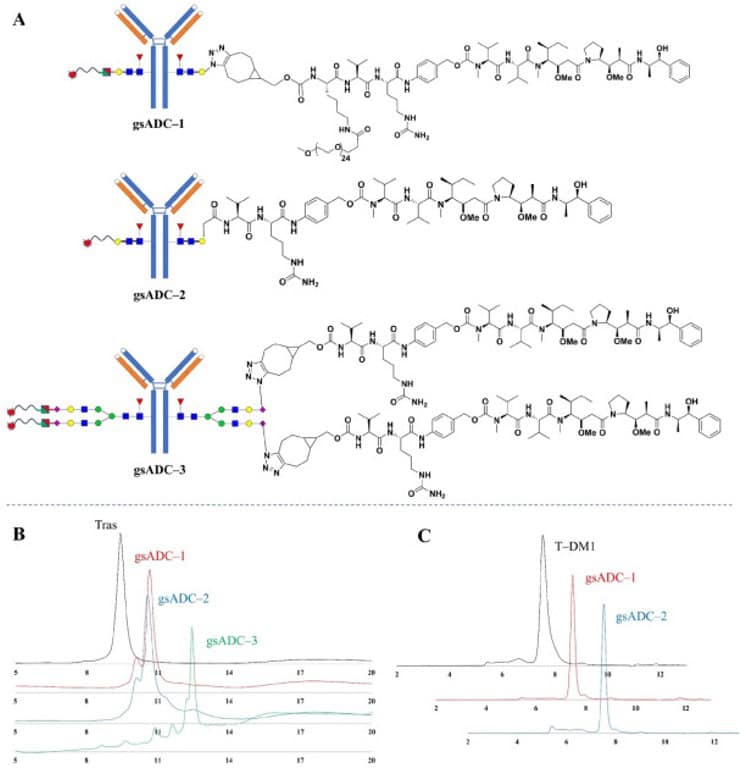 |
| Figure 3.0: HIC and SEC analysis of gsADCs. (A) Detailed structures of 3 gsADCs. (B) HIC analysis of 3 gsADCs. (C) SEC analysis of gsADC-1 and gsADC-2. |
Beyond manufacturability, the therapeutic properties of LacNAc-based gsADCs provide strong support for clinical translation. In vitro cytotoxicity assays showed consistent sub-nanomolar potency across multiple HER2-positive cancer cell lines, with IC₅₀ values[5] of 0.045 nM for SK-Br-3 cells, 0.152 nM for NCI-N87 cells (Table 1). Importantly, HER2-negative cell lines exhibited IC₅₀ values greater than 100 nM, establishing a clear therapeutic window and strong selectivity profile. For ADC developers, this pharmacological predictability reduces the uncertainty that often clouds early ADC programs, where variable DAR distributions can translate into inconsistent potency across batches. By offering reproducible activity aligned with molecular homogeneity, the one-step method creates a firmer foundation for dose selection and patient stratification in clinical development.
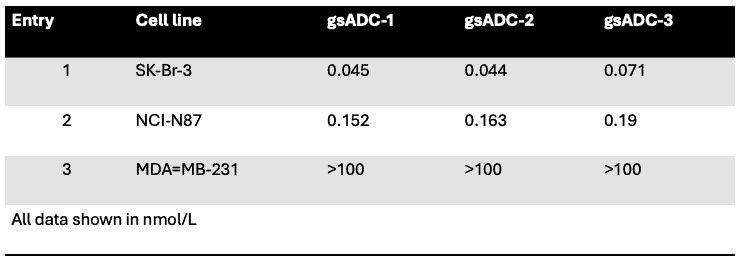 |
| Table 1.0: IC50 values of gsADCs against SK-Br-3, NCI-N87 and MDA-MB-231 |
In vivo studies provided further evidence of this approach’s promise. In xenograft mouse models, LacNAc-based gsADCs achieved sustained tumor suppression for more than 50 days following a single dose. This result compared favorably with less homogeneous ADC formats, in which tumors often regrew more rapidly. [6]
Wei Huang et al compared several versions of ADCs: Two made with the new LacNAc method (both had 2 drug molecules attached per antibody), one made with a different method using cysteine, and another made with a more traditional “biantennary sugar” approach, which carried 4 drug molecules per antibody. For LacNAc-based gsADC-1 and gsADC-2 (DAR = 2), both exhibited unremitting tumor inhibition, showing a much better in vivo efficacy than full-glycan gsADC-3 (DAR = 4) (Fig. 4A and C). These findings highlight the translational potential of site-specific conjugation strategies not only to improve potency but also to extend the durability of therapeutic response.
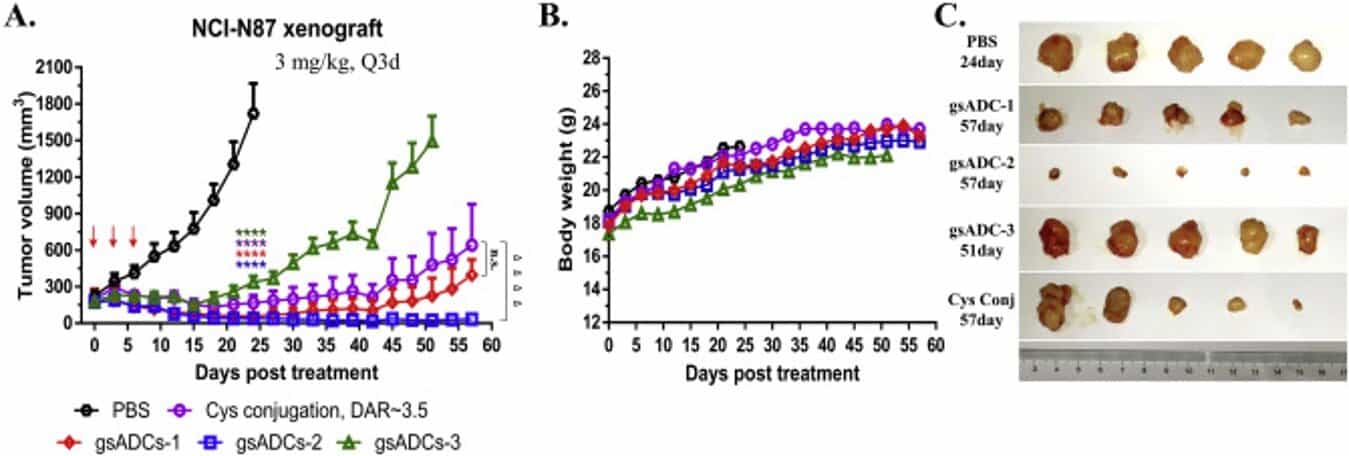 |
| Figure 4.0: In vivo efficacy assay of 4 ADCs on the NCI-N87 xenograft mice model. (A) Tumor volume curve. Red arrows indicate the time-points of ADC administration. A two-tailed t-test was used to assess statistical significance between the treatment and control groups. ∗∗∗∗P < 0.0001, comparing all ADCs with vehicle; ▹▹▹▹P < 0.0001, comparing gsADC-2 with Cys-conjugated ADC (n = 5 per group). Data = mean ± SEM. (B) Body weight curve. (C) Tumor images after dissection. |
For ADC developers, the operational benefits of one-step glycoengineering are substantial. A reaction that reaches completion in just one hour, rather than the extended multi-day workflows typical of traditional conjugation, directly increases facility efficiency. Shorter processes reduce cleanroom occupancy and free capacity to serve multiple clients. The standardization of a one-step method simplifies technology transfer, reducing the risks and time required for onboarding new programs. With consistent DAR and homogeneous product outcomes, ADC developers can also reduce their reliance on extensive analytical characterization, instead focusing on streamlined workflows that verify identity, purity, and stability. This, in turn, shortens project timelines and enables faster delivery of material for preclinical and clinical studies.
Strategically, adopting LacNAc-based glycoengineering allows ADC developers to differentiate themselves in an increasingly competitive manufacturing landscape. For smaller biotechs with limited internal CMC resources, the ability to rely on CDMO partners with proven expertise in one-step site-specific conjugation could make the difference between timely clinical entry and costly program delays. To do so, it is necessary to partner CDMOs that can not only deliver high-quality products but also accelerate time-to-clinic and reduce overall costs.
The broader implications of this platform also extend into regulatory management strategy. With homogeneous ADCs, the identification of critical quality attributes becomes far simpler, enabling developers to establish tighter specifications and provide regulators with clearer evidence of process control. Stability profiles that demonstrate resilience under stress further strengthen regulatory packages, potentially accelerating approval timelines by reducing the need for long-duration real-time stability studies.
Looking ahead, the adoption of one-step glycoengineering has the potential to reshape biotech–CDMO partnership dynamics. Traditional ADC manufacturing has historically concentrated capabilities among a small number of global CDMOs with highly specialized infrastructure. The complexity and risk of multi-step conjugation limited the number of viable partners, often creating bottlenecks and capacity shortages. The simplicity and robustness of the LacNAc-based approach lowers technical barriers, making CDMOs that leverage the LacNac-based approach more attractive to biotechs as potential partners. Nevertheless, challenges remain. Scaling the one-step method from laboratory to manufacturing scale requires validation that high yields and homogeneity are maintained across larger production volumes. Intellectual property and licensing considerations must also be navigated to ensure freedom to operate. Moreover, while regulators are likely to view the enhanced consistency and homogeneity favorably, ADC developers and CDMOs must still generate comprehensive comparability data and establish robust impurity controls. Addressing these challenges will be key to realizing the full potential of one-step glycoengineering in commercial ADC production.
As a leading CDMO, BioDlink focuses on technology development to enable product or process development, helping biotechs better develop their products. The company is also committed to strategic alliances that deliver meticulous fine-tuning to optimize combinations and targets, making reliable, agile partnerships essential.
Based on the core GL-DisacLink® platform technology developed by the Wei Huang team, BioDlink achieved breakthrough optimizations in process scale-up and streamlining, resulting in a substantial reduction in production costs. An advanced site-specific conjugation (1-enzyme 1-step) technology that enhances ADC stability and efficacy beyond conventional linker methods. BDKcell™, BioDlink’s proprietary cell line construction platform, has a rapid, 14-week development cycle. These innovations offer significant process advantages, including high uniformity, simplified workflows, short reaction times, reduced off-target effects, and reduced overall production costs.
For ADCs, BioDlink can complete the entire process from DNA synthesis to toxicology study material release in just 7 months, and the full IND application within 11 months. For monoclonal antibodies, the timelines are 6 months and 10 months, respectively. In the face of global competition, it is more important to build a win-win global ecosystem than go for the lowest price. Driven by customer needs, we strive to balance quality, speed, and cost to maximize value.
In conclusion, Wei Huang, Ph.D., et al research demonstrates that one-step LacNAc-based glycoengineering is more than a laboratory innovation; it represents an important pathway for ADCs can be manufactured and developed. By combining rapid, high-yield conjugation with product homogeneity, enhanced stability, and consistent pharmacological profiles, this approach directly addresses the most pressing pain points in ADC development.
__
Note: * IgG stands for Immunoglobulin G, a type of antibody made by the human body.
** By using a natural enzyme (Endo-S2) and special sugar blocks (LacNAc) to “reprogram” the sugars on an IgG antibody, it creates a precise landing spot where a cancer-killing drug can be attached, making an ADC much more uniform and reliable.
*** A measurement used to show how much of the drug is needed to kill half of the cancer cells in the dish. The lower the number, the stronger the drug.
**** The LacNAc design is shorter and tucks the toxic drug molecules deeper inside the antibody’s structure, keeping the drug more stable in the bloodstream and helping it reach the tumor more effectively.
Reference
[1] Colombo R, Tarantino P, Rich JR, LoRusso PM, de Vries EGE. The Journey of Antibody-Drug Conjugates: Lessons Learned from 40 Years of Development. Cancer Discov. 2024 Nov 1;14(11):2089-2108. doi: 10.1158/2159-8290.CD-24-0708. PMID: 39439290.
[2] Shi W, Li W, Zhang J, Li T, Song Y, Zeng Y, Dong Q, Lin Z, Gong L, Fan S, Tang F, Huang W. One-step synthesis of site-specific antibody-drug conjugates by reprograming IgG glycoengineering with LacNAc-based substrates. Acta Pharm Sin B. 2022 May;12(5):2417-2428. doi: 10.1016/j.apsb.2021.12.013. Epub 2021 Dec 24. PMID: 35646546; PMCID: PMC9136568.
Authors: Jian Zhang, Ph.D. 1
1 BioDlink
Author: 1 Jian Zhang, Ph.D., Chief Operating Officer, BioDlink (corresponding author)
Key terms: ADC, antibody-drug conjugate, CDMO, contract development and manufacturing organizations, natural enzyme, Endo-S2, one-step synthesis of glycosite-specific ADCs.
Published In: ADC Review| Journal of Antibody-drug Conjugates
DOI: 10.14229/jadc.2025.12.04.001.
How to cite:
Zhang J. How CDMOs Can Unlock One-step, High-Yield and Homogeneous ADC Manufacturing – J. ADC. December 4, 2025. DOI: 10.14229/jadc.2025.12.04.001.
Final Editorial Review: December 3, 2025
History:
- Original Manuscript Received: November 28, 2025
- Review results received: November 29, 2025
- Manuscript accepted for publication: December 3, 2025
- Article published online: December 4, 2025
Conflict of Interest
The author does not have any competing interests.
Featured image Unsplash © 2020 – 2025 Used with permission.
© 2025 The Authors. Used with permission.
DOI: 10.14229/jadc.2025.12.04.001.

