

At the annual meeting of the American Association for Cancer Research (AACR), held April 17 – 22, 2026, in San Diego, CA., new preclinical data will be presented for three proprietary antibody-drug conjugate (ADC) assets—CS5007 (EGFR/HER3 ADC), CS5006 (ITGB4 ADC), and CS5008 (DLL3/SSTR2 ADC)—being developed by CStone Pharmaceuticals.
 These programs leverage CStone’s advanced ADC technology platform, designed for high stability, precise payload release, and potent, broad-spectrum antitumor efficacy. CStone’s ADC platform utilizes a hydrophilic, tandem-cleavable CSL20 linker for enhanced stability and controlled payload release, paired with exatecan, a validated topoisomerase I inhibitor that offers robust bystander effects and reduced multidrug resistance.
Tandem-cleavage linker
Tandem-cleavage linker strategies employ two sequential enzymatic steps to release the cytotoxic payload, typically involving a sterically hindered dipeptide protected by a monosaccharide such as glucuronide. This configuration prevents premature degradation in circulation and ensures that payload release occurs primarily inside the target cell. The process generally begins with an initial cleavage—often by β-glucuronidase—which removes the protective group, followed by a second cleavage (such as by a protease) that liberates the drug. This sequential mechanism greatly reduces premature payload release in plasma, thereby improving the tolerability of ADCs in hematopoietic tissues. Despite their high stability, tandem-cleavage linkers maintain efficient payload delivery in tumor models, resulting in a more favorable therapeutic index. Additionally, the hydrophilic nature of the protective group helps to offset the hydrophobicity of traditional peptide linkers, enhancing overall solubility. Collectively, these features expand the therapeutic window of ADCs, as demonstrated in studies comparing tandem-cleavage linkers to conventional vedotin linkers. [1]
CS5007: EGFR/HER3 Bispecific ADC
EGFR and HER3 are oncogenic receptors frequently co-expressed in a variety of epithelial malignancies. CS5007 is a bispecific ADC targeting both EGFR and HER3, addressing tumor heterogeneity and resistance mechanisms that undermine single-target approaches.


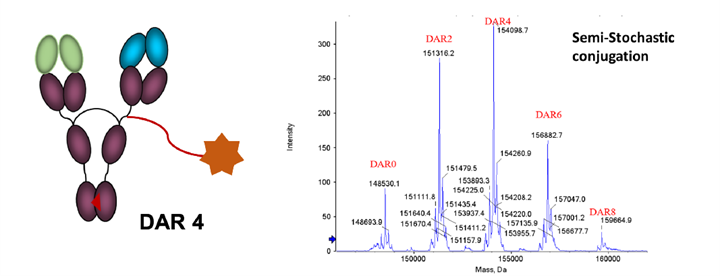
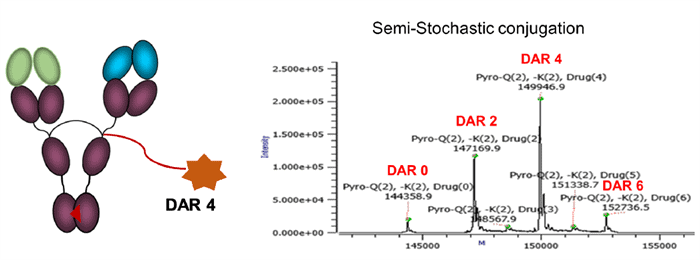
The investigational drug is constructed with a functional EGFR&HER3 arm to tackle tumor heterogeneity; a proprietary hydrophilic beta-glucuronide linker (CSL20 linker to ensure that the ADC has a mAb-like PK profile, stability, and tumor selective cleavage; and a potent, well-tolerated, and clinically validated topoisomerase 1 inhibitor exatecan conjugated to the antibody with a drug-to-antibody ratio of 4 (DAR4). [2]
In preclinical studies, CS5007 demonstrated high-affinity binding (in the single-digit nM range) to EGFR/HER3 single- and double-positive tumor cells, comparable to that of its naked bispecific antibody and its parental antibodies.
Preclinical findings further include:
- Superior Stability: CS5007 demonstrated exceptional plasma stability, with less than 0.5% free payload release after 7 days.
- Dual Pathway Inhibition: The bispecific antibody (J17; the naked antibody of CS5007) inhibits both EGFR and HER3 signaling, overcoming resistance seen with single-target agents.
- Rapid Internalization: Efficient and rapid uptake in cell lines with varied EGFR/HER3 expression, ensuring robust drug delivery.
- Potent and Broad-Spectrum Activity: Nanomolar, antigen-dependent cytotoxicity across NSCLC, breast, colorectal, pancreatic, and head and neck cancer cell lines.
- Effective Bystander Killing: CS5007 eliminated both antigen-positive and adjacent antigen-negative tumor cells in co-culture models, validating its ability to address tumor heterogeneity.
- In Vivo Efficacy: Demonstrated significant tumor growth inhibition in multiple xenograft models, including those resistant to EGFR inhibitors.
- Favorable PK/PD and Safety: CS5007 showed superior pharmacokinetics, a long half-life (~20 hours), and a wide safety margin in animal models. No lethal toxicity observed.
Preclinical findings indicate that the investigational agent binds with exceptional affinity, triggers rapid internalization across tumors with diverse EGFR and HER3 expression, effectively blocks dual downstream signaling pathways, and exhibits robust bystander-mediated tumor growth inhibition. These data provide a strong rationale to advance CS5007 into clinical investigation in solid tumors. Based on the demonstrated enhanced signaling inhibition, superior efficacy across multiple solid tumor models, and a favorable safety margin in preclinical studies, CStone plans a phase I clinical trial (CS5007-101) in advanced solid tumors, with an IND submission expected in early 2026.
The planned study will be a monotherapy dose-escalation and expansion study designed to evaluate safety and recommended phase 2 dose (RP2D) in patients with advanced solid tumors. The study plans to enroll approximately 70 adult patients with advanced solid tumors who have progressed on or are ineligible for standard treatment or have no effective treatment options.
CS5006: ITGB4-Targeting ADC
Integrin β4 (ITGB4) is highly expressed in multiple solid tumors and drives tumor progression and immune evasion. It exclusively pairs with Integrin α6 (ITGA6) to form the α6β4 heterodimer, a receptor for the basement membrane protein laminin. ITGB4 is highly expressed on the surface of various solid tumors, including CRC, NSCLC, HNSCC, and ESCC, while its expression in normal, healthy tissues is low.
Distinct from other β integrins, ITGB4 features a unique 1,000-amino acid cytoplasmic domain that may facilitate a rapid antigen turnover. It also integrates with and amplifies key signaling cascades—including ErbB2, PI3K, FAK/Akt, and c-Met—thereby driving tumor progression, upregulating PD-L1 expression, and mediating anti-PD-1 resistance via MEK/ERK signaling. [3]
CS5006 is a first-in-class ADC targeting ITGB4 with the following preclinical highlights:
- Highly Stable Linker-Payload System: Less than 0.6% free payload released after 7 days in serum.
- Potent, Specific Cytotoxicity: Nanomolar, antigen-dependent cell killing correlated with ITGB4 expression levels.
- Bystander Effect: Induced cytotoxicity in ITGB4-negative cells via bystander killing.
- Broad and Durable In Vivo Activity: Robust tumor inhibition across xenograft models of NSCLC, CRC, head and neck, urothelial, gastric, and breast cancer.
- Favorable PK and Safety: Half-life ~3.5 days and high non-severe toxic dose in non-human primates.
CS5006 is a highly promising first-in-class ADC targeting ITGB4, combining broad-spectrum and potent anti-tumor activity with favorable safety and PK profiles. Preclinical studies have demonstrated rapid, deep internalization and potent, specific killing of ITGB4-positive cells, with bystander-mediated elimination of ITGB4-negative cells, thereby exhibiting broad-spectrum and robust in vivo anti-tumor activity in xenograft models. In NHPs, CS5006 exhibits a favorable HNSTD and half-life. Furthermore, it also demonstrates impressive CMC profiles, including high antibody yield, strong ADC stability, and favorable developability. Collectively, the preclinical data provide strong support for the clinical development of CS5006.
IND submission for CS5006 is planned for the second half of 2026.
CS5008: DLL3/SSTR2 Bispecific ADC
DLL3 and SSTR2 are commonly overexpressed in small cell lung cancer (SCLC) and neuroendocrine tumors (NETs/NECs). CS5008 is a first-in-class bispecific ADC designed to address tumor heterogeneity and resistance due to subtype switching.[4]
CS5008 is 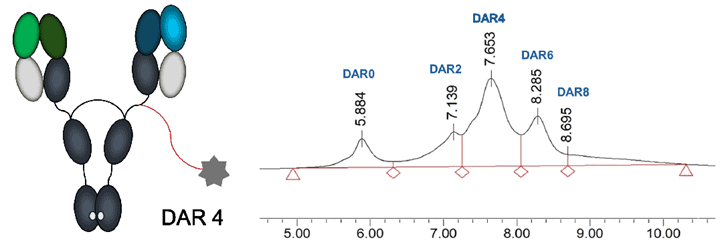 based on CStone’s proprietary modular ADC platform, and comprises a bispecific antibody with high affinity for both DLL3, a clinically validated target in SCLC, and SSTR2, a well-established target in neuroendocrine tumors (NETs/NECs), a proprietary tandem-cleavable β-glucuronide linker (CSL20), and the topoisomerase 1 inhibitor exatecan as payload (DAR4). CS5008 is designed to overcome tumor heterogeneity in SCLC and NETs by simultaneously targeting two clinically validated antigens with complementary expression profiles.
Preclinical findings further include:
- Excellent Serum Stability: Toxin release rate under 0.5% after 7 days in primate and human serum.
- Dual Internalization Pathways: Rapid and robust uptake in cells expressing DLL3 and/or SSTR2.
- Antigen-Dependent Cytotoxicity: Efficient killing in cell lines and in vivo models with varying DLL3/SSTR2 expression.
- Broad-Spectrum In Vivo Activity: Single-dose tumor regression in multiple SCLC CDX models; outperformed DLL3-only ADC in DLL3-negative models.
- Favorable PK and Safety: Long half-life (~14 days) and broad safety margin in non-human primates.
- Strategy to Overcome Subtype Resistance: By targeting both DLL3 and SSTR2, CS5008 may overcome therapy-induced subtype switching, a major challenge in SCLC.
Favorable preclinical studies demonstrated potent antitumor activity against SCLC by dual targeting of SSTR2 and DLL3, effectively addressing heterogeneity, supporting further clinical development of CS5008. IND submission is anticipated by the end of 2026.
CStone’s proprietary ADC platform yields highly stable, potent, and broad-spectrum ADCs with favorable safety profiles. CS5007, CS5006, and CS5008 each address unique tumor targets and mechanisms of resistance, supporting their advancement to clinical evaluation. These assets represent promising approaches for the treatment of diverse and challenging solid tumors.
__
Reference
[1] Chuprakov S, Ogunkoya AO, Barfield RM, Bauzon M, Hickle C, Kim YC, Yeo D, Zhang F, Rabuka D, Drake PM. Tandem-Cleavage Linkers Improve the In Vivo Stability and Tolerability of Antibody-Drug Conjugates. Bioconjug Chem. 2021 Apr 21;32(4):746-754. doi: 10.1021/acs.bioconjchem.1c00029. Epub 2021 Mar 9. PMID: 33689309.
[2] Wang C, Wang Y, Zhang N, Zhang X, Li Y, Qian Y, Chen Y, Yang Y, Liu X, Zhu M, Dai H, Xiang W, Dai X, Ma F, Yang J. Preclinical efficacy and safety of CS5007, an EGFR×HER3 dual-targeting antibody-drug conjugate with a topoisomerase 1 inhibitor payload. In: Proceedings of the 117th Annual Meeting of the American Association for Cancer Research; 2026 April 17-22; San Diego, CA.: AACR; 2026. Abstract nr 1823 / 11
[2] Wang C, Zhang X, Zhang N, Wang Y, Li Y, Zhu M, Liu X, Chen Y, Qian Y, Yang Y, Sun J, Ma F, Yang J. Preclinical efficacy and safety of CS5006, a novel integrin β4-targeting antibody-drug conjugate with a topoisomerase 1 inhibitor payload. In: Proceedings of the 117th Annual Meeting of the American Association for Cancer Research; 2026 April 17-22; San Diego, CA.: AACR; 2026. Abstract nr 1821 / 9
[3] Wang C, Li Y, Zhang N, Wang Y, Zhang X, Liu X, Qian Y, Dai H, Dai X, Chen Y, Zheng Z, Xiang W, Ma F, Yang J. Preclinical efficacy and safety of CS5008, a novel SSTR2×DLL3 bispecific antibody-drug conjugate (ADC) with topoisomerase 1 inhibitor payload for small cell lung cancer and neuroendocrine tumors. In: Proceedings of the 117th Annual Meeting of the American Association for Cancer Research; 2026 April 17-22; San Diego, CA.: AACR; 2026. Abstract nr 1822 / 10
Featured image: San Diego, CA – The AACR 2026 Annual Meeting – Photo Courtesy © 2026 AACR/Scott Morgan.
DOI