




OncoPrecision’s investigational CD64-targeting antibody-drug conjugate ONC001, developed using patient-derived biology to guide target and payload selection, is advancing toward clinical evaluation following a strategic investment and manufacturing partnership with mAbxience.
Key takeaways
- ONC001 is an investigational, first-in-class antibody-drug conjugate (ADC) targeting CD64, developed for monocytic acute myeloid leukemia (AML) and chronic myelomonocytic leukemia (CMML).[1]
- CMML is a rare, heterogeneous myeloid malignancy classified as a myelodysplastic syndromes/myeloproliferative neoplasm (MDS/MPN) overlap syndrome by the World Health Organization (WHO). [1]
- Patient-derived ex vivo screening identified PNU-159682 as the payload with the strongest activity against malignant monocytic cells, leading to the development of ONC001 with a non-cleavable linker.
- mAbxience has made a strategic investment in OncoPrecision and will develop the antibody component of ONC001, including cell line, process, and analytical development, and manufacture the first good manufacturing practice (GMP) batch for a planned Phase I clinical trial.
Developing antibody-drug conjugates (ADCs) increasingly depends on identifying not only an appropriate tumor-associated target but also a payload that addresses the biological characteristics of the targeted cells. OncoPrecision’s investigational ADC ONC001 illustrates this approach. Developed using patient-derived biological models to guide target identification and payload selection, ONC001 targets CD64, a receptor expressed across monocytic leukemia populations, including cells associated with resistance to conventional treatment.
On November 18, 2026, OncoPrecision and Madrid-based (Spain) mAbxience announced a strategic investment and development and manufacturing agreement intended to advance ONC001 toward clinical evaluation. Under the agreement, mAbxience will oversee development of the antibody component, covering cell line development, process development, and analytical development. The company will also manufacture the first GMP-grade batch to support a planned Phase 1 clinical trial.
The agreement marks an important manufacturing milestone for OncoPrecision, a New York-based biotechnology company developing precision oncology therapeutics by integrating patient-derived biology and artificial intelligence (AI). It also adds an investigational ADC program to mAbxience’s CDMO activities, a biopharmaceutical developer and manufacturer wholly owned by Fresenius SE & Co. KGaA.
CD64 as a therapeutic target in monocytic leukemia
ONC001 was developed to address a major therapeutic challenge in CMML and monocytic AML, particularly the French-American-British (FAB) M4 and M5 subtypes. These malignancies are characterized by malignant cells with monocytic differentiation. According to the investigators, patients with these diseases may respond poorly to standard-of-care treatments, with low rates of complete remission. The researchers proposed that the intrinsic treatment resistance of malignant monocytes contributes to this clinical challenge.
Identifying a suitable ADC target in these diseases is particularly challenging. An effective target must be expressed across relevant malignant cell populations while being expressed at low levels in normal hematopoietic stem cells and other hematopoietic lineages. This expression profile is important for establishing a potential therapeutic window and limiting damage to healthy blood-forming cells.
The ONC001 development program identified Fc gamma receptor I (FcγRI), also known as CD64, as a potential target. CD64 is a high-affinity immunoglobulin G (IgG) Fc receptor expressed on myeloid lineage cells, including monocytes and macrophages. In the investigators’ ex vivo profiling of more than 100 patients with myeloid leukemia across multiple clinical studies, CD64 was highly expressed on monocytic precursors and mature monocytes from patients with CMML and AML. Expression levels were reported to be as much as three times higher than those observed in monocytes from healthy donors.
The investigators also considered evidence identifying CD64 as a marker of monocytic leukemic stem cells. These cells may lack conventional leukemic stem cell markers, including CD34, as well as monocytic markers such as CD14. This expression pattern provided an additional rationale for investigating CD64 as a therapeutic target.
Together, these observations supported the development of an ADC intended to deliver a cytotoxic payload selectively to CD64-expressing malignant cells.[2]
Patient-derived biology guided target and payload selection
A distinguishing feature of ONC001’s development is the use of OncoPrecision’s Patient Micro-Avatar (PMA) platform to evaluate target engagement and payload activity directly in patient-derived biological samples. Rather than relying exclusively on established cancer cell lines, the investigators used peripheral blood mononuclear cell (PBMC) and bone marrow mononuclear cell (BMMC) samples from patients with different forms of monocytic leukemia. The evaluation included patients with CMML, M4 AML, and M5 AML, as well as patients with M0 AML, whose primitive leukemic cells did not express CD64.
The screening program evaluated CD64-targeting ADCs conjugated to different cytotoxic payloads. The experiments demonstrated target engagement and internalization, supporting the feasibility of using CD64 to deliver an ADC payload into malignant monocytic cells. Payload selection proved particularly important. PNU-159682 (PNU) emerged as the payload with the most favorable activity against the monocytic leukemic cells examined.
Notably, exatecan and monomethyl auristatin E (MMAE), payloads used in ADCs with established clinical development histories in other malignancies, demonstrated limited or no activity against the malignant monocytes evaluated in these experiments. This finding highlighted the importance of matching payload pharmacology to the biological characteristics of the target cell population, rather than assuming that payloads active in other cancers would produce comparable results in monocytic leukemia. The resulting development candidate, ONC001, combines a CD64-targeting antibody with PNU-159682 through a non-cleavable linker.[1]
ONC001 demonstrates selective activity in patient-derived samples
In preclinical testing, ONC001 demonstrated picomolar activity against a panel of monocytic leukemia cell lines in vitro and against CD64-positive malignant monocytes obtained from 27 patients. The investigators also reported a distinct expression-dependent activity profile. ONC001 activity was lost in myeloid cells that did not express CD64, including M0 AML blasts, and in cells derived from the lymphoid compartment, including T cells, B cells, and natural killer (NK) cells. These findings support the relationship between CD64 expression and ONC001 activity in the experimental systems studied.
In patient-derived samples, the ADC demonstrated substantial single-agent activity against malignant cells from patients with CMML and M4/M5 AML. The investigators reported greater ex vivo activity than azacitidine and venetoclax in the samples evaluated. The researchers also examined ONC001 in combination with azacitidine and venetoclax. In an expanded cohort of 44 patients, they observed activity in combination, particularly in samples from patients with M1/M2 AML.
These observations suggest that ONC001 may warrant further investigation both as a single agent in CD64-positive monocytic malignancies and in combination with existing AML treatments. However, the reported findings are based on ex vivo experiments and do not establish clinical benefit or predict treatment outcomes in patients.[1]
Activity in mouse leukemia models
The investigators also evaluated ONC001 in two complementary mouse cell-line-derived xenograft (CDX) models using human monocytic leukemia cell lines THP-1 and MV-4-11. At 1 mg/kg, ONC001 demonstrated single-agent activity in both models.
In a kinetic subcutaneous xenograft model, a single administration of ONC001 resulted in complete remission in all animals evaluated. Responses remained durable for up to seven weeks following single or double dosing. In a separate orthotopic disseminated leukemia model, a single administration also produced complete remissions in all animals at the one-week assessment endpoint.
The investigators reported no signs of off-target toxicity in either model. They observed no changes in body weight or significant alterations in complete blood counts or clinical chemistry measurements used to monitor liver and kidney function. Although these results provide additional preclinical support for ONC001, the findings remain limited to the experimental models studied. The reported absence of toxicity in these mouse models does not establish safety in humans.
Manufacturing partnership supports clinical development preparations.
The manufacturing agreement with mAbxience addresses the antibody production requirements for the next stage of ONC001 development. Under the agreement, mAbxience will lead the antibody development program, beginning with cell line development and extending through process and analytical development. The collaboration includes manufacturing the first GMP-grade batch for the planned Phase 1 clinical trial.
The agreement does not disclose the financial terms of mAbxience’s investment or provide details on manufacturing the complete ADC drug product, including payload conjugation. mAbxience will contribute its experience in antibody development, technology transfer, process development, and GMP manufacturing. The company’s Smart CoGs approach is also intended to support cost-efficient development and manufacturing.
As part of the strategic investment, Jurgen Van Broeck, Chief Executive Officer of mAbxience, will join OncoPrecision’s Board of Directors as an observer. For mAbxience, the agreement expands its work with biotechnology companies developing investigational oncology therapeutics. The company specializes in biopharmaceutical development and manufacturing, including biosimilars and CDMO services, and operates three multiproduct drug substance manufacturing facilities in Spain and Latin America.
mAbxience became a wholly owned subsidiary of Fresenius in September 2026, after Fresenius acquired the remaining 45% stake from Insud Pharma. Fresenius had acquired a majority interest in the company in 2022. The completed acquisition brought mAbxience fully into Fresenius Kabi’s Biopharma business, giving the group full ownership of its development and manufacturing platform. The company has more than 15 years of experience in biopharmaceutical development and manufacturing, a workforce of more than 1,300 employees, and a commercial presence in more than 100 markets.
Advancing a patient-guided ADC development strategy
ONC001 represents an ADC development approach in which patient-derived biological evidence informs decisions about target selection and payload compatibility. The ASH 2025 data presented by OncoPrecision investigators established the initial preclinical rationale for targeting CD64 in monocytic leukemia and identified PNU-159682 as a payload with activity against malignant monocytic cells. The subsequent manufacturing agreement with mAbxience provides a development and manufacturing framework for producing the antibody component ahead of planned clinical evaluation.
The next stage will require completion of the necessary manufacturing and clinical development activities, followed by evaluation of ONC001 in human studies. Its potential to address CD64-positive monocytic leukemia, including CMML and M4/M5 AML, will ultimately depend on clinical evidence of safety, pharmacological activity, and therapeutic benefit.
For now, the available findings provide a preclinical foundation for further investigation of CD64 as an ADC target and illustrate how patient-derived screening can inform the selection of both the target and cytotoxic payload during ADC development.
Reference
[1] Chan O, Renneville A, Padron E. Chronic myelomonocytic leukemia diagnosis and management. Leukemia. 2021 Jun;35(6):1552-1562. doi: 10.1038/s41375-021-01207-3. Epub 2021 Mar 13. PMID: 33714974.
[2] Garro C, Buffa L, Marin C, Monjes N, Garcia-Melani A, Cavallo N, et al. ONC001: A first-in-class ADC targeting CD64 for the treatment of monocytic leukemia developed through patient-guided target and payload selection. Blood. 2025;146(suppl 1):324. doi:10.1182/blood-2025-324
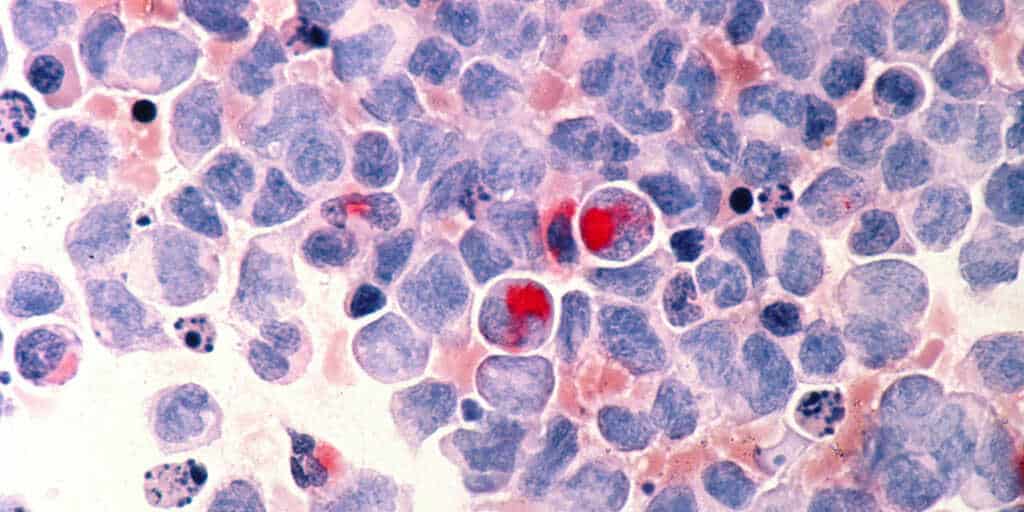
Featured image: Human cells with acute myelocytic leukemia (AML) in the pericardial fluid, shown with an esterase stain at 400x. Courtesy: © This image was released by the National Cancer Institute, an agency of the National Institutes of Health. Used with permission.
DOI
