

Abstract
Antibody-drug conjugates (ADCs) have transformed targeted cancer therapy by combining the specificity of monoclonal antibodies with the cytotoxic potency of small-molecule drugs. However, payload instability, hydrophobicity, and premature cleavage limit their efficacy and safety. This study presents Exo-Linker technology as a novel solution to these issues. By repositioning cleavable peptide linkers like Glu-Val-Cit and Glu-Glu-Val-Cit at the exo-position of the p-aminobenzyl carbamate moiety, Exo-Linkers improve stability, hydrophilicity, and resistance to enzymatic degradation.
Key findings highlight the superior pharmacokinetics, tumor-suppressive efficacy, and enzymatic stability of Exo-Linker ADCs in preclinical models, significantly outperforming traditional Val-Cit-based linkers. Integration with the second-generation AJICAP platform broadens therapeutic windows, ensures precise drug-to-antibody ratio control, and minimizes aggregation. Exo-Linkers establish a new standard for ADC development, overcoming critical limitations of traditional linkers while enabling safer and more effective cancer treatments. This innovative approach redefines the therapeutic landscape, enhances patient outcomes, and broadens the scope of ADC applications.
- Introduction
The rapid advancement of Antibody-drug conjugates (ADCs) has revolutionized targeted cancer therapies, providing a powerful strategy to enhance therapeutic precision and efficacy [1]. ADCs utilize the specificity of monoclonal antibodies (mAbs) to deliver highly cytotoxic small-molecule payloads directly to tumor cells through specialized chemical linkers, minimizing systemic toxicity.
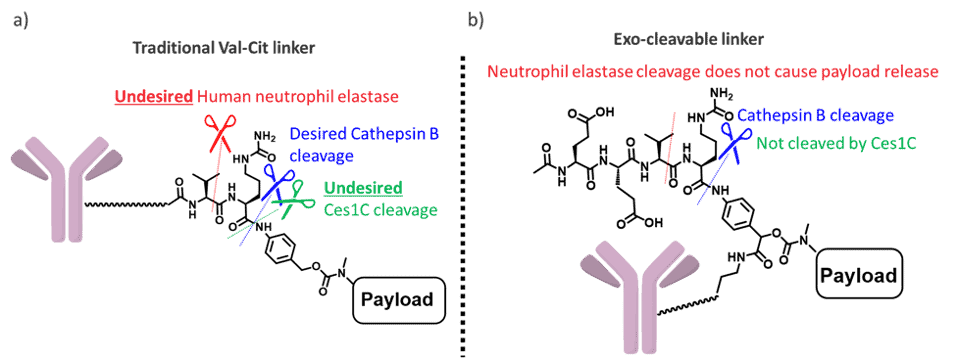
Over 13 ADCs have received U.S. Food and Drug Administration (FDA) approval, with more than 100 candidates in various stages of clinical development. Despite this progress, significant challenges persist, particularly regarding conventional linker technologies’ stability, safety, and efficacy limitations (Figure 1). This study presents the Exo-Linker platform, a novel approach that overcomes these issues by incorporating advanced linker chemistry, conjugation methods, and ADC optimization to enhance therapeutic outcomes [2].
- Current Challenges in Linker Technology
2.1. Role of Linkers in ADC Design
Linkers are essential to ADC functionality, directly impacting structural homogeneity, pharmacokinetics (PK), and therapeutic safety margins. They are broadly classified as cleavable or non-cleavable. Linkers must remain stable in systemic circulation regardless of type to prevent premature payload release while ensuring efficient and selective drug delivery at the tumor site. Cleavable linkers, especially enzyme-cleavable designs, are preferred for clinical applications. The valine-citrulline (Val-Cit) linker is the most widely used, relying on cathepsin B-mediated cleavage. This mechanism enables precise payload release after ADC internalization and lysosomal degradation, making it a cornerstone in ADC design for targeting various cancers.
2.2. Limitations of Val-Cit Linkers
Despite extensive validation in primate and human plasma models, Val-Cit linkers have critical limitations that restrict their broader applicability in ADCs:
- Hydrophobicity and aggregation:
The p-aminobenzyl carbamate (PAB) moiety in Val-Cit linkers adds significant hydrophobicity, limiting the drug-to-antibody ratio (DAR) to modest levels. Efforts to increase the DAR often cause ADC aggregation, reducing efficacy, pharmacokinetic stability, and safety.
- Premature cleavage:
Val-Cit linkers are prone to enzymatic degradation by non-specific enzymes such as carboxylesterase Ces1C and human neutrophil elastase (NE). This degradation can cause premature payload release, off-target toxicity, and adverse clinical outcomes, including neutropenia, ultimately compromising the therapeutic potential of ADCs with Val-Cit linkers.
- Payload compatibility:
The hydrophobicity of Val-Cit linkers limits their compatibility with hydrophobic payloads, often necessitating co-solvents or complex manufacturing processes to ensure payload solubility and stability. These requirements increase production costs and complicate ADC development pipelines.
These challenges highlight the need for novel linker technologies that address the limitations of Val-Cit linkers while preserving or enhancing therapeutic efficacy and safety.
- Exo-Linker Technology: Design and Advantages
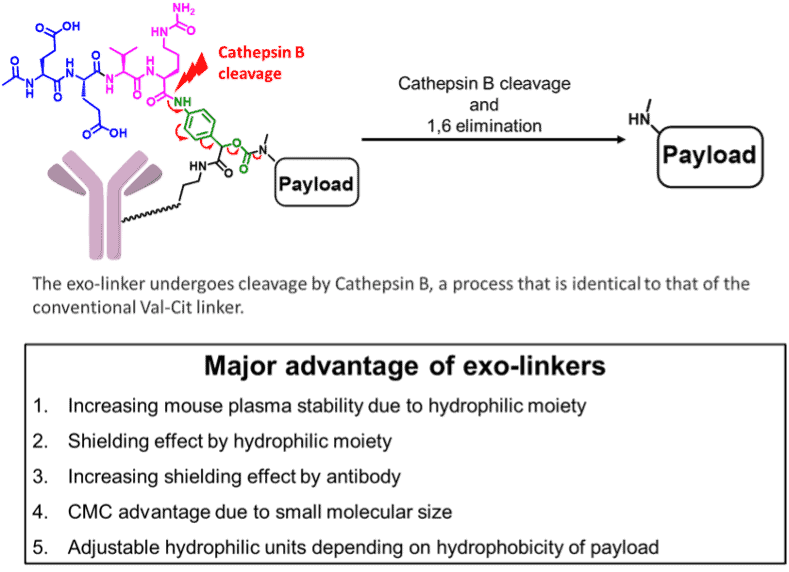
Exo-Linker technology represents a paradigm shift in ADC development by addressing the limitations of traditional Val-Cit linkers (Figure 2). This innovative approach repositions cleavable peptide linkers, such as Glu-Val-Cit (EVC)—a linear variant resistant to CES1C [3] —and Glu-Glu-Val-Cit (EEVC), to the exo-position of the PAB moiety. By leveraging the hydrophilicity of tetrapeptides and optimizing structural design, Exo-Linkers improve ADC stability, mitigate hydrophobicity-related challenges, and enhance therapeutic efficacy.
3.1. Molecular Design
The Exo-Linker incorporates glutamic acid residues that confer resistance to enzymatic degradation by non-cathepsin B enzymes, like carboxylesterase Ces1C and NE. This repositioning masks the payload’s hydrophobicity and shortens the structural distance between the antibody and payload, improving plasma stability, reducingaggregation, and enhancing intracellular payload release.
3.2. Key Advantages
- Improved Stability:
Exo-Linkers demonstrate exceptional plasma stability. Studies in mouse plasma showed that free payload concentrations remained below 5% after four days of incubation, underscoring the linker’s resistance to premature cleavage.
- Improved Hydrophilicity:
Hydrophobic interaction chromatography (HIC) analyses revealed faster retention times for ADCs with Exo-Linkers than those with traditional linear Val-Cit and EVC linkers. This highlights the improved hydrophilic profile of Exo-Linkers, which reduces aggregation and enhances pharmacokinetics.
- Resistance to NE-mediated cleavage:
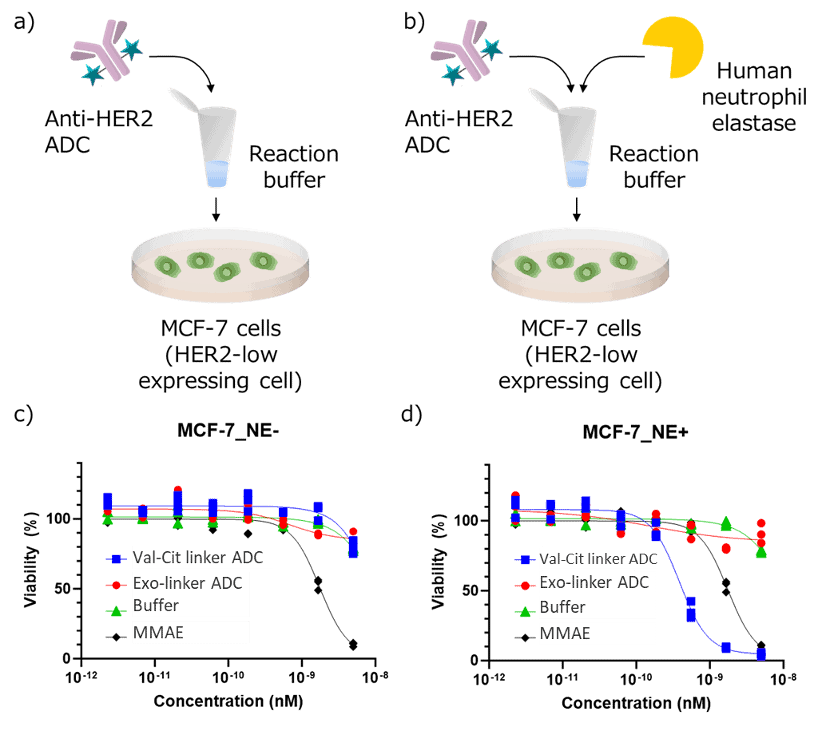
Val-Cit linkers are susceptible to NE, which cleaves the bond between valine and citrulline, causing premature detachment of Cit-PAB payloads, increasing potential off-target toxicity and side effects. In our study, Exo-Linkers remained intact under NE exposure, preventing premature payload release and enhancing stability. To confirm this, we tested ADCs with Val-Cit and Exo-Linkers in an NE-sensitive setup using HER2-low MCF-7 cells (Figure 3). Without NE, all ADCs except MMAE performed similarly. However, with NE, Val-Cit ADCs exhibited higher cytotoxicity, likely due to the hydrophobicity of Cit-PAB-MMAE, which enhances cell penetration. In contrast, Exo-Linker ADCs avoided this effect, maintaining stability and minimizing off-target risks. These results show that Exo-Linkers overcome the critical weaknesses of Val-Cit linkers, offering a safer and more reliable option for ADC development. This technology marks a significant advancement in enhancing ADC safety and therapeutic potential.
Simplified Manufacturing:
The small molecular size of Exo-Linkers streamlines production and quality control, offering a distinct advantage in manufacturing efficiency. Their intrinsic hydrophilicity eliminates the need for co-solvents during payload conjugation, enhancing compatibility with various payloads and enabling the design of ADCs with higher DARs.
- Functional Insights into Exo-Linker Technology
4.1. Payload Compatibility and Hydrophilicity
The compatibility of Exo-Linkers with hydrophobic payloads was demonstrated using pyrene as a model compound. Comparative analyses showed that ADCs with a high DAR of 8, synthesized using Exo-Linkers, exhibited significantly reduced aggregation compared to those with Val-Cit or linear EVC linkers. LogP evaluations confirmed the enhanced hydrophilic properties of Exo-Linkers, demonstrating their ability to mask payload hydrophobicity. This hydrophilic advantage contributes to improved pharmacokinetic stability and reduced off-target interactions, which are critical factors in ADC performance.
4.2. In Vivo Efficacy
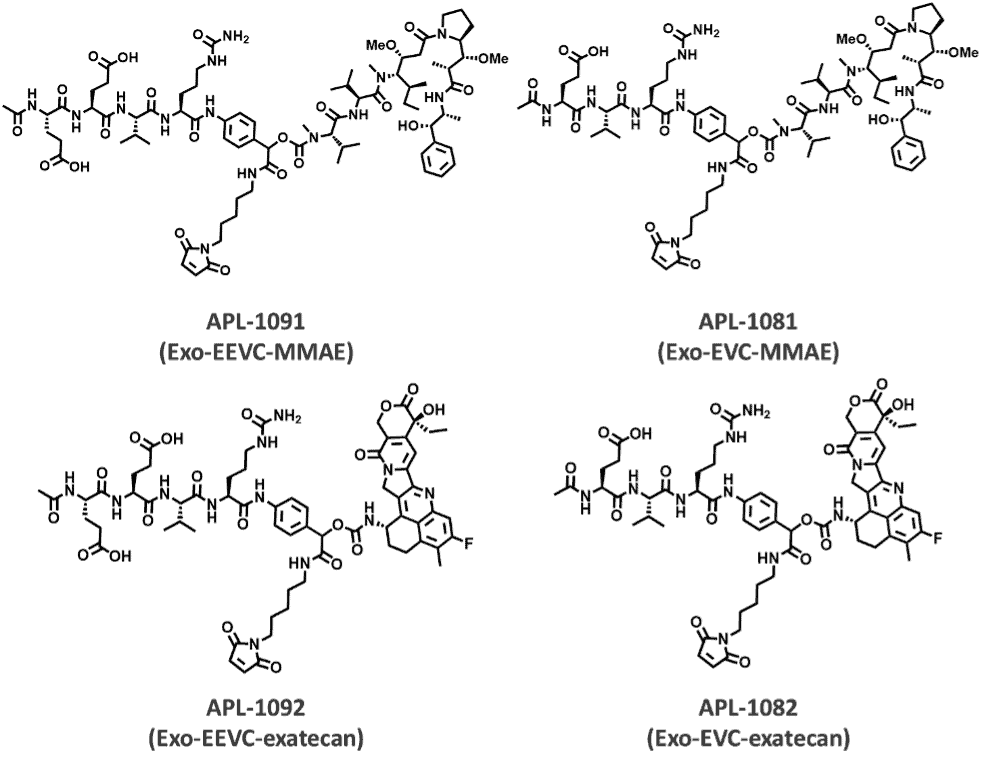
Exo-Linker ADCs have demonstrated superior therapeutic efficacy in xenograft models. In studies with HER2-positive NCI-N87 cells, ADC consiting of APL-1091 or APL-1092 (Figure 4) showed better tumor suppression than traditional ADCs with linear EVC or Val-Cit linkers. Exo-Linker ADCs achieved these results at lower doses, indicating improved therapeutic potency and a broader therapeutic index than conventional designs.
4.3. Pharmacokinetics
Rat PK studies validated the stability of Exo-Linker ADCs, showing minimal reductions in DAR over 21 days, in contrast to the significant payload detachment observed with traditional Val-Cit linker-based ADCs. This improved DAR retention demonstrates Exo-Linkers’ ability to maintain payload integrity in vivo, resulting in more consistent therapeutic outcomes and extended efficacy over time [4].
4.4. Resistance to enzymatic interference
The robustness of Exo-Linkers against enzymatic degradation was demonstrated in cytotoxicity assays using NE. Traditional Val-Cit ADCs showed increased off-target toxicity due to premature payload release from NE cleavage. In contrast, Exo-Linker ADCs retained their payloads and resisted NE-mediated interference. This enzymatic stability reduces side effects and ensures targeted payload delivery, improving safety and efficacy.
- Integration with AJICAP Technology
Integrating Exo-Linker technology with the AJICAP Second Generation Platform marks a significant advancement in ADC development [5]. Developed by Ajinomoto, the AJICAP method enables site-specific conjugation by introducing thiol groups at predetermined antibody sites, such as Lys248, ensuring precise DAR control and reducing heterogeneity [6]. This site-specific approach enhances the advanced properties of Exo-Linkers, offering synergistic benefits for ADC development:
- Expanded therapeutic window
- Improved Solubility and Stability
- Superior Antitumor Efficacy
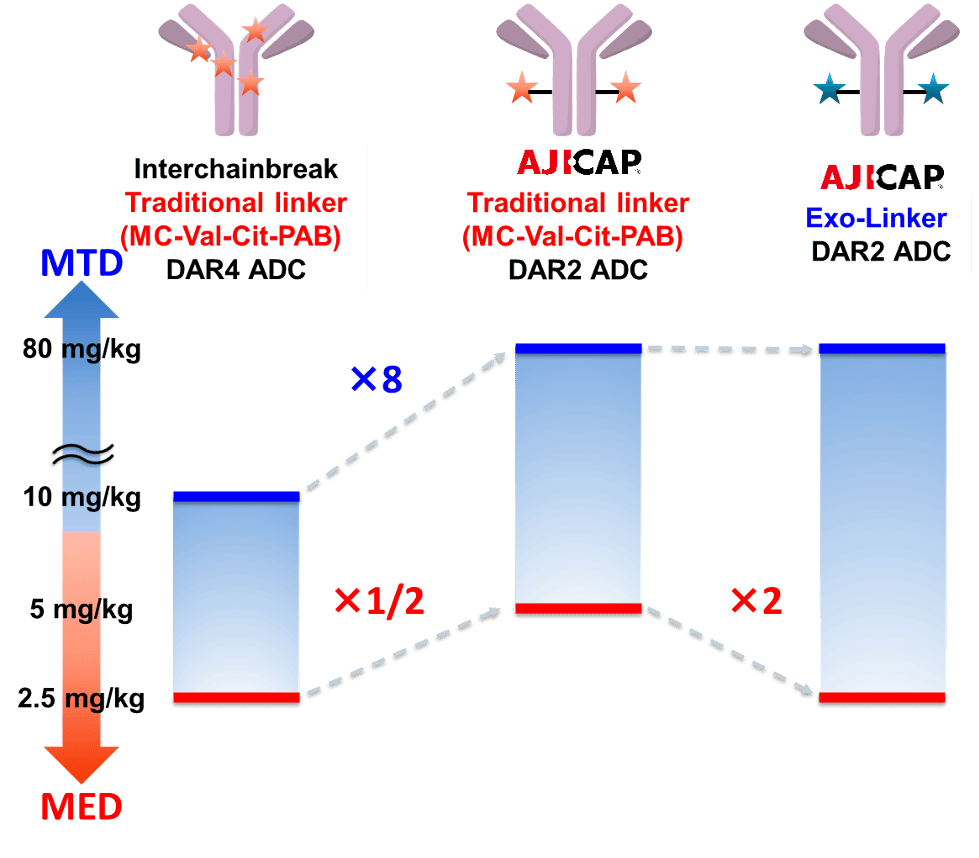
Figure 5 illustrates a comparative analysis of therapeutic indices for three linker technologies and conjugation strategies used in ADCs. The therapeutic index, defined as the ratio of the maximum tolerated dose (MTD) to the minimum effective dose (MED), is crucial for assessing the safety and efficacy profiles of ADCs. The first category represents ADCs using traditional interchain break conjugation methods with MC-Val-Cit-PAB MMAE under good laboratory practice. These ADCs have a limited MTD, indicating an increased likelihood of dose-limiting toxicity at elevated concentrations. Additionally, a relatively high MED is needed to achieve therapeutic efficacy. The narrow therapeutic window highlights the challenges in balancing safety and efficacy for ADCs with traditional linker technologies. In contrast, the DAR = 2 site-specific ADC incorporating the AJICAP conjugation platform with MC-Val-Cit-PAB-MMAE linkers shows a remarkable improvement in MTD, approximately an 8-fold increase than traditional counterparts. This improvement significantly expands the therapeutic window, reflecting the superior pharmacokinetics and reduced systemic toxicity enabled by site-specific conjugation. The AJICAP system overcomes critical limitations of conventional ADCs by enhancing homogeneity and DAR control. Finally, site-specific ADCs synthesized with AJICAP and Exo-Linker technologies extend the therapeutic index by reducing the MED. Exo-Linker technology, with exo-positioned peptide linkers (e.g., Glu-Val-Cit), enhances ADC hydrophilicity, reduces aggregation, and improves plasma stability. It mitigates premature cleavage from enzymatic interference (e.g., carboxylesterase and neutrophil elastase) and simplifies conjugation. As a result, Exo-Linker ADCs show optimal pharmacokinetic stability and a broader therapeutic window, enabling lower doses and reduced toxicity, even at higher concentrations.
Conclusion
Exo-Linker technology significantly advances ADC development, offering enhanced stability, hydrophilicity, and resistance to enzymatic degradation. Its synergy with innovative conjugation methods like AJICAP highlights its transformative potential. By overcoming the limitations of conventional linkers, Exo-Linkers set a new standard for safer, more effective ADCs, shaping the future of targeted cancer therapy.
References
[1] C. Dumontet, J. M. Reichert, P. D. Senter, J. M. Lambert, A. Beck, Antibody-Drug Conjugates Come of Age in Oncology. Nat. Rev. Drug Discov. 2023; 22: 641.
[2] T. Watanabe, N. Arashida, T. Fujii, N. Shikida, K. Ito, K. Shimbo, T. Seki, Y. Iwai, R. Hirama, N. Hatada, Exo-Cleavable Linkers: Enhanced Stability and Therapeutic Efficacy in Antibody–Drug Conjugates. J. Med. Chem. 2024; 67: 18124.
[3] Y. Anami, C. M. Yamazaki, W. Xiong, X. Gui, N. Zhang, Z. An, K. Tsuchikama, Glutamic Acid-Valine-Citrulline Linkers Ensure Stability and Efficacy of Antibody-Drug Conjugates in Mice. Nat. Commun. 2018; 9: 2512.
[4] T. Watanabe, T. Fujii, J. Y. Matsuda, Exo-Cleavable Linkers: Enhancing Stability and Therapeutic Efficacy in Antibody-Drug Conjugates. J. Synth. Org. Chem., Jpn. 2024; 8: 1117.
[5] T. Fujii, Y. Matsuda, T. Seki, N. Shikida, Y. Iwai, Y. Ooba, K. Takahashi, M. Isokawa, S. Kawaguchi, N. Hatada, T. Watanabe, R. Takasugi, A. Nakayama, K. Shimbo, B. A. Mendelsohn, T. Okuzumi, K. Yamada, AJICAP Second Generation: Improved Chemical Site-Specific Conjugation Technology for Antibody–Drug Conjugate Production. Bioconjugate. Chem. 2023; 34: 728.
[6] Y. Matsuda, N. Shikida, N. Hatada, K. Yamada, T. Seki, Y. Nakahara, Y. Endo, K. Shimbo, K. Takahashi, A. Nakayama, B. A. Mendelsohn, T. Fujii, T. Okuzumi, S. Hirasawa, AJICAP-M: Traceless Affinity Peptide Mediated Conjugation Technology for Site-Selective Antibody–Drug Conjugate Synthesis. Org. Lett. 2024; 26: 5597.
Authors: Tomohiro Watanabe*1, Tomohiro Fujii, Ph.D *2, Yutaka Matsuda, Ph.D, Ph.D, MBA,*1
1 Ajinomoto Bio-Pharma Services, 11040 Roselle Street, San Diego, CA 92121, United States; 2 Ajinomoto Co., Inc., 1-1, Suzuki-Cho, Kawasaki-Ku, Kawasaki-Shi, Kanagawa 210-8681, Japan.
Corresponding Authors: Tomohiro Watanabe, Tomohiro Fujii, Ph.D, Yutaka Matsuda, Ph.D, Ph.D, MBA
Key terms: antibody-drug conjugate, stable linker, site-specific conjugation, enzymatic cleavable linker, AJICAP
Published In: ADC Review| Journal of Antibody-drug Conjugates
DOI: https://doi.org/10.14229/jadc.2024.12.30.001
How to cite:
Tomohiro Watanabe, Tomohiro Fujii, Ph.D, Yutaka Matsuda, Ph.D, Ph.D, MBA
Exo-Linker: Positional Reconfiguration Driving Significant Advances in ADC Stability and Efficacy – J. ADC. December 30, 2024. DOI: 10.14229/jadc.2024.12.30.001.
Last Editorial Review: December 23, 2024
Article History:
- Original Manuscript Received December 1, 2024
- Review results received December 21, 2024
- Manuscript accepted for publication December 23, 2023
- Article published online: December 30, 2024
Featured Image: Courtesy: © The Authors. Used with permission.
Acknowledgment
The authors thank their former and current colleagues at Ajinomoto Co., Inc. and Ajinomoto Bio-Pharma Services, Inc. for their invaluable contributions. Special thanks go to Tsubasa Aoki, Rika Takasugi, Noriko Hatada, Yumiko Suzuki, Ryusuke Hirama, and Kei Yamada for their technical assistance with AJICAP conjugations; Monica Leung, Veronica Robles, and Zhala Tawfiq for their support with ADC preparation; and Natsuki Shikida, Naoko Arashida, Kazutoshi Takahashi, Kenichiro Ito, and Kazutaka Shimbo for their contributions to ADC analysis. The authors also thank Takuya Seki, Yuri Ooba, Sayaka Kawaguchi, Yusuke Iwai, Ryo Yamada, and Akira Nakayama for their work on in vivo and in vitro studies. Additionally, they acknowledge Tessa Ente Barnes, Akira Chiba, Hiroki Imai, Brian A. Mendelsohn, and Tatsuya Okuzumi for their valuable insights and suggestions during manuscript preparation and ADC project discussions.
Author Contribution
We, the sole authors, have read the paper, attest to the validity of its contents, and agree to its submission.
Conflict of Interest
The authors do not have any competing interests.
Figure Legends
Figure 1.0: Illustration of Exo-linker technology. a) traditional Val-Cit linker, b) Exo-cleavable linker
Figure 2.0: Design and benefits of exo-linkers
Figure 3.0: Evaluation of off-target toxicity of ADCs using an in vitro cytotoxicity assay: (A, B) Schematic representation of the assay under a) NE-depleted and b) NE-pre-treated conditions. Anti-HER2 ADCs treated or untreated with NE in the NE-reaction buffer and incubated with MCF-7 cells (C, D) Cell viability after incubation with (c) untreated and (d) NE-treated ADCs and MMAE.
Figure 4.0: Chemical structure of Exo-linker payloads.
Figure 5.0: Comparison of therapeutic indices of three ADC designs: (1) a stochastic DAR = 4 ADC synthesized using the interchain break conjugation method with MC-Val-Cit-PAB-MMAE (left), (2) a site-specific DAR = 2 ADC generated through the AJICAP conjugation method with MC-Val-Cit-PAB-MMAE (middle), and (3) a site-specific DAR=2 ADC using the AJICAP conjugation method with exo-linker-MMAE (right). Each design illustrates the impact of conjugation strategy and linker technology on the safety and efficacy profile of the ADC.
DOI: 10.14229/jadc.2024.12.30.001.

