



Peptide-drug conjugates (PDCs) are an emerging class of targeted therapeutics that combine the specificity of peptides with the potent efficacy of cytotoxic drugs. These conjugates leverage peptides as targeting ligands to deliver drugs selectively to diseased cells, such as cancerous or infected tissues, thereby minimizing off-target toxicity. Used as an umbrella term PDCs include a variety of conjugates using different types of peptides.*
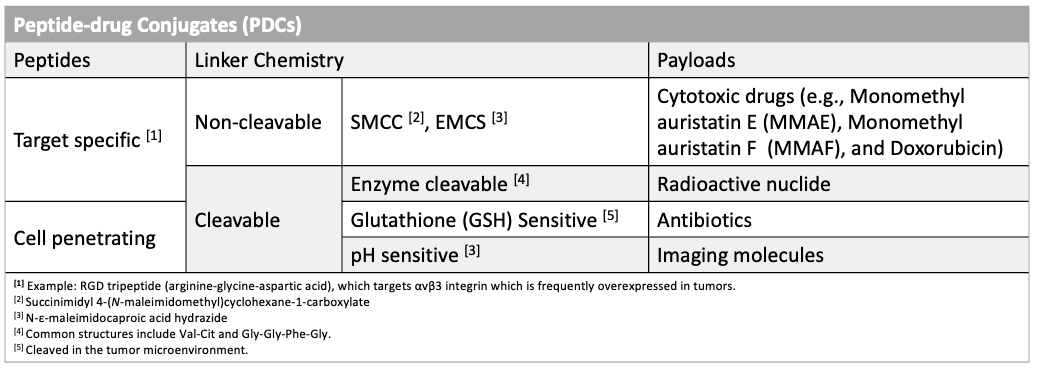
The design of PDCs involves three key components: a targeting peptide, a linker, and a payload. The peptide is typically selected based on its ability to recognize and bind to over-expressed receptors on diseased cells, ensuring precise drug delivery. The linker plays a crucial role in controlling drug release, which can be triggered by specific conditions like enzymatic cleavage or pH changes in the tumor microenvironment.[1]
Compared to antibody-drug conjugates (ADCs) which are clinically established for the treatment of cancer and hematological malignancies, PDCs are slowly gaining recognition as a potential new treatment modality which offer a variety of advantages. These advantages are, in essence, based on differences between an ADC and a PDC. For example, the size of an antibody, typically >1000 amino acids (~ 150 kDa), is much larger than the size of a peptide, which ranges from 5–25 amino acids in length. The smaller size, better tissue penetration, and lower immunogenicity result in PDC with which are better targeting intracellular pathways, where antibodies may struggle to enter.[2]


Advances in peptide engineering, which also includes modifications to enhance stability and binding affinity, are further improving the efficacy of PDCs currently in preclinical and clinical trial settings where PDCs are being studies in various therapeutic areas, including oncology, infectious diseases, and metabolic disorders.[2]
As research continues to progress, optimizing peptide selection, linker chemistry, and payload potency will be critical in developing next-generation PDCs with superior safety and efficacy profiles.
Market Insights
Based on a report from DelvelInsight Business Research, North America dominated the global peptide drug conjugates market in 2024, accounting for the largest share of 56.70%. The market is expected to grow at a CAGR of 28.47% from 2025 to 2032, primarily driven by the increasing incidence of cancer in the U.S. Additionally, the region’s market growth is fueled by rising collaborations among key industry players for PDC development and increasing investments in this sector.
Furthermore, major companies in North America are emphasizing research and development to create innovative peptide-drug conjugates. For instance, in February 2021, Theratechnologies announced that the U.S. Food and Drug Administration (FDA) granted fast-track designation to sudocetaxel zendusortide (TH1902; see Drugmap)**, a docetaxel-based peptide-drug conjugate, for treating patients with sortilin-positive recurrent advanced solid tumors that are resistant to standard therapies. [3]
Novartis and PeptiDream Collaboration
In April 2024, Novartis, which already has two FDA-approved PDC drugs***, expanded its collaboration with Japans PeptiDream to further develop peptide-drug conjugates in a deal exceeding US $ 2.8 billion.
Under the multi-program agreement, PeptiDream will use its proprietary Peptide
Discovery Platform System (PDPS®-) technology to identify and optimize novel
macrocyclic peptides against targets selected by Novartis for potential conjugation to
radionuclides (known as radioligand therapies or RLTs) or other applications for both therapeutic and diagnostic purposes.
The agreement between Novartis and PeptiDream expands upon the peptide-drug conjugate (PDC) collaboration the companies announced in 2019, and further highlights the two companies’ long-standing discovery efforts, originally initiated in 2010, and extended multiple times, including Novartis’s licensing of PeptiDream’s PDPS technology in 2015.
The agreement between Novartis and PeptiDream contributes to the overall anticipated growth of the peptide-drug conjugates market.
The increasing global prevalence of cancer is fueling the demand for peptide-drug conjugates as targeted therapies, providing improved effectiveness and lower systemic toxicity than conventional treatments. In the DelvelInsight Business Research (Peptide-drug Conjugate Market Insights) the authors describe the current market condition and forecast analysis, individual leading peptide-drug conjugate companies’ market shares, challenges, peptide-drug conjugate market drivers, barriers, trends, and key market peptide-drug conjugate companies in the market.
The peptide-drug conjugate market is witnessing significant growth, driven by advancements in targeted therapies and the increasing prevalence of cancer and other chronic diseases. PDCs combine the specificity of peptides with the potency of cytotoxic drugs, offering an improved therapeutic index compared to traditional chemotherapy. With growing interest in precision medicine, pharmaceutical companies are heavily investing in PDC research and development, leading to an expanding pipeline of clinical candidates.
One of the key market drivers is the rising demand for novel drug delivery systems that enhance efficacy while minimizing off-target effects. Peptides, due to their high specificity and low immunogenicity, serve as excellent carriers for cytotoxic payloads. Additionally, advancements in peptide synthesis and linker technologies have improved the stability and half-life of PDCs, making them more viable for clinical applications. Companies such as Bicycle Therapeutics and PeptiDream are leading the innovation in this space.
Despite the promising outlook, the PDC market faces challenges such as manufacturing complexities, high development costs, and regulatory hurdles. Peptide synthesis and conjugation processes require stringent quality control, and scalability remains a concern. Furthermore, competition from other targeted therapies, such as ADCs and small-molecule inhibitors, poses a challenge for widespread adoption.
Looking ahead, growth opportunities exist in expanding indications beyond oncology, such as antimicrobial, autoimmune, and neurodegenerative diseases. Strategic collaborations between biotech firms and large pharmaceutical companies are accelerating clinical development, while advancements in artificial intelligence and computational modeling are further refining peptide design and optimization. With ongoing innovations and increasing investments, the PDC market is poised for substantial expansion in the coming years.
Summary
- North America is anticipated to dominate the global peptide-drug conjugate market during the forecast period.
- With a market share of 37% in 2024 Lutetium 177Lu dotatate (Lutathera®; Novartis), a radioactive drug used to treat gastroenteropancreatic neuroendocrine tumors (GEP-NETs), is expected to dominate the peptide drug conjugates market
- Notable peptide-drug conjugate companies including Novartis, Oncopeptides, Cybrexa Therapeutics, Avacta Therapeutics, ProteinQure, Theratechnologies, CBP, Soricimed Biopharma, NMS Group, Mainline Scientific, Bicycle Therapeutics, and several others, are currently operating in the peptide-drug conjugate market.
- In April 2024, PeptiDream announced the expansion of its peptide discovery collaboration with Novartis Pharma. Using its proprietary Peptide Discovery Platform System (PDPS®), PeptiDream identified and optimized macrocyclic peptides for conjugation with radionuclides for therapeutic and diagnostic applications.
- In March 2023, Ono Pharmaceutical Co., announced that it entered into a drug discovery collaboration agreement with PeptiDream, to discover and develop novel macrocyclic constrained peptide drugs against multiple targets of being reviewed by Ono Pharmaceuticals.
__
Note:* PDCs include different conjugates using different types of peptides, including bicycle-toxin conjugates (BTC) and peptide-dendrimer conjugates which both have shown promise as potential drug delivery systems. For example, a bicycle peptide is typically between 9–20 amino acids long and has 3 cysteine residues within the sequence. [3] These cysteine residues react with a small molecule linker to constrain the peptide in a rigid conformation.[4] These bicycles are constrained bicyclic peptides that represent a promising binding modality for use in targeted drug conjugates which can be used as transporters for toxin payloads (drug) molecules through bicycle-toxin conjugates (BTCs). The tumor-targeted BTC directs the specific payload to a specific cell or tissue for release and targeted therapeutic response. A single BTC can also be joined with each other to form higher order structures including tandems, trimers, and tetramers, allowing them to engage targets and target classes inaccessible to traditional small molecules or to engage multiple drug targets or cell types simultaneously. In comparison to antibody-drug conjugates or ADCs, BTCs offer several advantages which include deeper tumor penetration, rapid extravasation and slower renal clearance.[5] Bicycle Therapeutics is currently developing a variety of BTCs, including BT1718, BT5528 and BT8009 all targeting specific tumors.
** Sudocetaxel zendusortide (TH1902) is a first-in-class Peptide-drug conjugates (PDCs) targeting SORT1, consisting of 2 molecules of docetaxel attached to the TH19P01 peptide via a cleavable succinyl linker. The drug was assessed in a triple-negative breast cancer (TNBC-) derived immunocompromised xenograft tumor model where complete tumor regression was observed for more than 40 days after the last treatment.[6][7]
*** Including lutetium 177Lu vipivotide tetraxetan (Pluvicto®; Novartis) and 177Lu oxodotreotide (Lutathera®; Novartis)
Clinical trials
TH1902 in Patients With Advanced Solid Tumors – ClinicalTrials.gov ID NCT04706962
Highlight of prescribing Information
Lutetium 177Lu dotatate/Lutetium (177Lu) oxodotreotide (Lutathera®; Novartis) [Prescribing Information]
Lutetium 177Lu vipivotide tetraxetan (Pluvicto®; Novartis)[Prescribing Information]
Reference
[1] Chavda VP, Solanki HK, Davidson M, Apostolopoulos V, Bojarska J. Peptide-Drug Conjugates: A New Hope for Cancer Management. Molecules. 2022 Oct 25;27(21):7232. doi: 10.3390/molecules27217232. PMID: 36364057; PMCID: PMC9658517.
[2] Heh E, Allen J, Ramirez F, Lovasz D, Fernandez L, Hogg T, Riva H, Holland N, Chacon J. Peptide Drug Conjugates and Their Role in Cancer Therapy. Int J Mol Sci. 2023 Jan 3;24(1):829. doi: 10.3390/ijms24010829. PMID: 36614268; PMCID: PMC9820985.
[3] Heinis C, Rutherford T, Freund S, Winter G. Phage-encoded combinatorial chemical libraries based on bicyclic peptides. Nat Chem Biol. 2009 Jul;5(7):502-7. doi: 10.1038/nchembio.184. PMID: 19483697.
[4] Mudd GE, Brown A, Chen L, van Rietschoten K, Watcham S, Teufel DP, Pavan S, Lani R, Huxley P, Bennett GS. Identification and Optimization of EphA2-Selective Bicycles for the Delivery of Cytotoxic Payloads. J Med Chem. 2020 Apr 23;63(8):4107-4116. doi: 10.1021/acs.jmedchem.9b02129. Epub 2020 Apr 2. PMID: 32202781.
[5] Cooper BM, Iegre J, O’ Donovan DH, Ölwegård Halvarsson M, Spring DR. Peptides as a platform for targeted therapeutics for cancer: peptide-drug conjugates (PDCs). Chem Soc Rev. 2021 Feb 15;50(3):1480-1494. doi: 10.1039/d0cs00556h. PMID: 33346298.
[6] Shah S, Sharma M, Metcalfe A, Roy G, Douglas LM, Marsolais C, Winer IS. Sudocetaxel zendusortide (TH1902), a novel sortilin-receptor (SORT1)-targeting peptide-drug-conjugate (PDC) in patients (pts) with advanced solid tumors: Results from part 1 (dose-escalation) of a phase 1, open-label study. Journal of Clinical Oncology 2023 41:16_suppl, 3089-3089
[7] Demeule M, Currie JC, Charfi C, Zgheib A, Cousineau I, Lullier V, Béliveau R, Marsolais C, Annabi B. Sudocetaxel Zendusortide (TH1902) triggers the cGAS/STING pathway and potentiates anti-PD-L1 immune-mediated tumor cell killing. Front Immunol. 2024 Feb 16;15:1355945. doi: 10.3389/fimmu.2024.1355945. PMID: 38482021; PMCID: PMC10936008.
Featured image © 2022 – 2025 licensed under the Unsplash+ License. Used with permission
DOI


